Water running on the day of the visit does not prove that availability has been certified, and the meter feeding an office unit is not always registered to the property itself. These are two separate documents, issued by different bodies, and a buyer who asks for neither inherits whatever was never checked.
Service availability is evidenced by a certification from the utility company for that specific property, and it is the document the curaduría looks at when a permit is requested. A seller's word, a temporary hook-up or a line drawn from a neighbour are not the same thing, and the difference decides whether an office unit can be lived in, conveyed or remodelled. Alongside that sits the bill: in Colombia utility balances follow the property rather than the person who ran them up, so the account status and the name recorded on the meter belong in the promesa de compraventa (the binding promise of sale) and not in an act of trust. How much is owed is for the utility to state; who pays it is what gets agreed in writing before signing.
An office unit is bought differently because it does not live on passing footfall but on the building's ability to work as a business address. What makes it usable are services the unit does not control: the hours lifts and security actually run, the air conditioning and how it is metered, backup power, connectivity and visitor parking. None of that is fixed inside the unit and all of it runs through the administración, so the review looks at the building rather than at the door. The second difference is destinación, the recorded permitted use: in mixed-use towers, units whose registered use is residential are routinely sold as offices, and the mismatch between what the deed says, what the reglamento allows and what planning rules require is what later blocks registering the activity or receiving the public. The third is the rental market: an office tenant is a company choosing on address, floor area and building services, and is replaced by another of the same kind, so occupancy depends on the state of the whole tower far more than on the state of the unit.
Bocagrande works like a mature resale market, with consequences that do not repeat up north. The counterparty is almost never a builder: it is a long-standing owner or, very often, an unsettled sucesión, an estate proceeding, whose heirs live in different countries, so closing depends not on one power of attorney but on several, and on the partition among them. The registry record is old too: it was opened when the building was submitted to the condominium regime, it carries legacy entries such as cancelled mortgages, patrimonio de familia and afectación a vivienda familiar, both family-home protections, or lifted attachments, and the recorded area does not always match a current survey, so you compare the registry record against the deed and against the unit's floor plan. The peninsula is also land reclaimed from the sea under subdivisions the District authorized in their day, and the oldest deeds still carry references to those parcelaciones, the original platting. Day-to-day power sits with the owners' assembly and its manager, so in a tower with a long record of decisions the minutes and the status of the condominium's lawsuits matter more than the brochure.
What is specific to Bocagrande
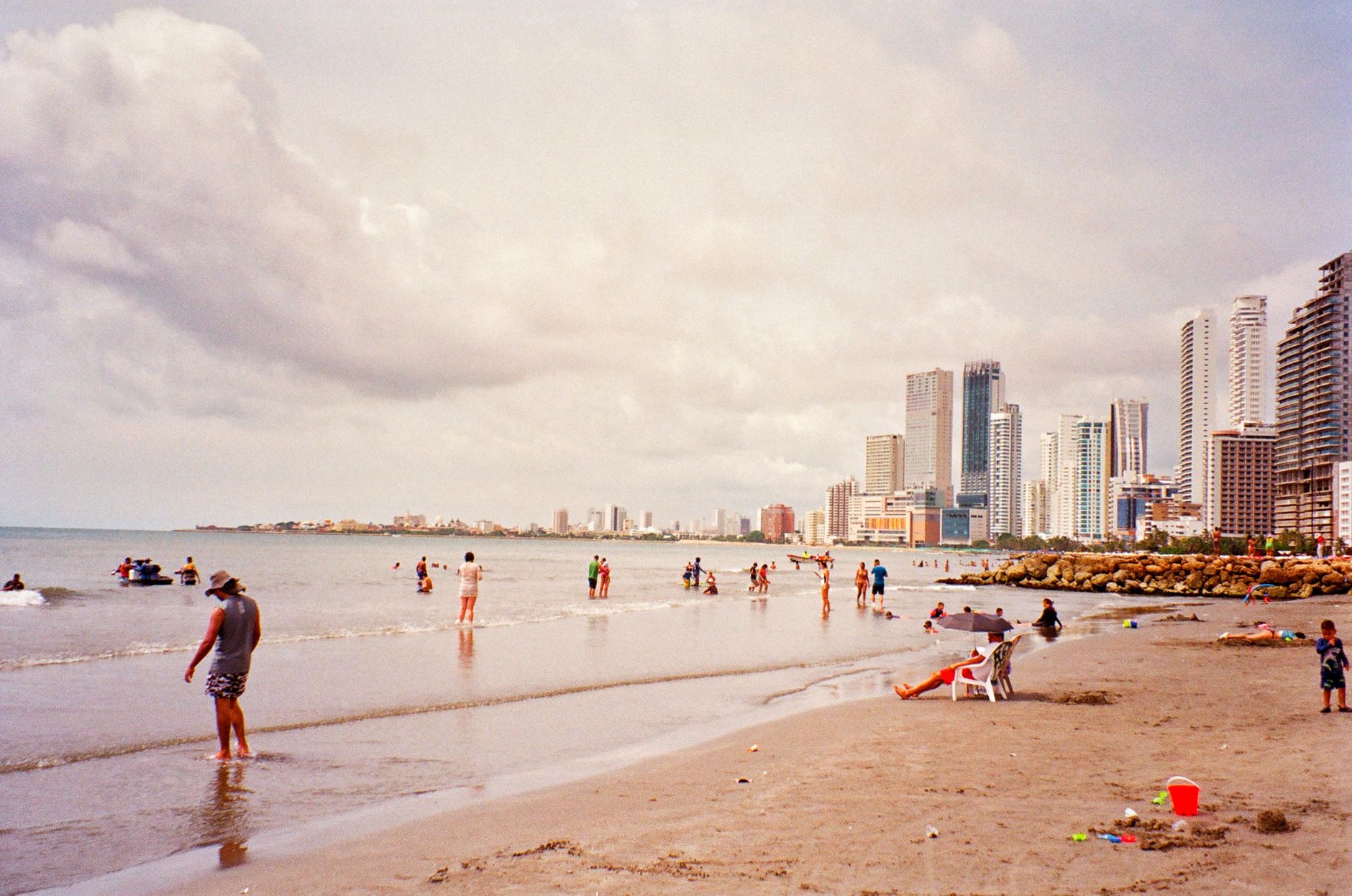
Cartagena's dense, vertical peninsula: open sea on one side, bay on the other, and built out to the last lot. Condominium towers from very different eras, from the sixties to recent construction, on the same block. Groceries, restaurants and beach are walkable, and access is through a few roads that saturate in high season.
- the building's actual age and whether it has a structural vulnerability study, since much of the stock was built under seismic codes earlier than those now in force
- what the condominium bylaws say about daily rentals, which on this peninsula is the difference between being able to rent and not
- how many parking spaces the unit holds in the deed, not in the brochure, because older towers do not have one per apartment
What to verify, step by step
- Ask the utility company for a water and sewer availability certification issued for the property's registry folio, not for the development or the sector.
- Request the latest account statement for each service and ask the company whether there are payment arrangements, refinancings or disputed charges on that meter.
- Check whose name the meter is in and whether it matches the unit being shown: in a copropiedad, individual meters sit next to common-area services billed through the dues.
- Check what belongs to an office unit itself and does not change with the sector: whether the deed's permitted use is office or residential, because in mixed-use towers residential units are routinely sold as offices; the hours the lifts, air conditioning and security actually operate, and whether use outside those hours is billed separately and whether the administración requires a declared destinación (recorded permitted use) and prior notice to receive the public, and which visitor parking is assigned to the unit.
- Check in addition what Bocagrande requires in particular, with the authority that imposes it: the building's actual age and whether it has a structural vulnerability study, since much of the stock was built under seismic codes earlier than those now in force; what the condominium bylaws say about daily rentals, which on this peninsula is the difference between being able to rent and not and how many parking spaces the unit holds in the deed, not in the brochure, because older towers do not have one per apartment.
- Have the promesa state who answers for balances predating closing, and ask for the paz y salvo (a clearance certificate for the account) before signing; it can be requested without being in Colombia.
Mistakes that cost money
- Treating the bill the seller shows you as an account statement. A bill covers one billing period; a statement shows the balance and any arrangements in force.
- Assuming service because the main runs along the street. A main in front of the lot and a metered connection to the lot are different things, and on land purchases that is exactly where the sums fail.
- Forgetting common-area services. In a copropiedad the lift, pump and lighting consumption arrives through the administration dues, not through the unit's own bill.
Frequently asked questions
- Does the seller's utility debt pass to the buyer?
- The balance is charged against the property, so it is a point to be agreed expressly in the promesa. Ask the utility for a certification of the account status and have your attorney review how that clause was drafted.
- Who issues the availability certification?
- The company that provides the service at that property. The curaduría and the Alcaldía require it as an annex, but they do not issue it.
- Can all of this be requested from outside Colombia?
- The account statement and the certification are requested from the utility and in several cases handled online. Where the request has to come from the owner, the seller files it and you receive the document in writing.
Where to check it
- Alcaldía Mayor de Cartagena de Indias — property tax, betterment levies and District procedures
- Plan de Ordenamiento Territorial de Cartagena — land use, the rules applying to the property and protected land
- Curadurías Urbanas de Cartagena — whether a current building or subdivision permit exists and exactly what it authorises
- Cartagena de Indias — the rules of the municipality Bocagrande belongs to
Official bodies. Specific figures are requested there, not copied from a listing.
Updated 2026-11-06
Interested in a property in this area?
Write to us and we will send you the available options.