A lot in Morros is not worth what it measures but what the rules let you put on it, and that fact is never in the listing. Lot sellers rarely mention it, because it is precisely what shrinks the project you had in mind.
Every property carries an occupancy ratio and a floor-area ratio, setbacks from neighbours and from the road, a maximum height, a required number of parking spaces and mandatory land contributions. Those parameters are not citywide: they come from the treatment and polygon the POT (the city's land-use plan) assigns to that property, and they are fixed when the curaduría urbana issues the permit. In the Zona Norte further constraints stack on top and none of them shows on a survey: aviation easements capping height near the airport, water setbacks and mangrove where Cardique has a say, public-domain land where DIMAR does. We publish none of those values, because the only ones that matter are the ones the curaduría certifies for your lot.
What you buy in Morros is not land but a private unit created by subdividing a single folio matriz, the parent registry record, and that changes the file. The chain of title on the land was settled once by the builder; what remains to review is the registered reglamento de propiedad horizontal, the condominium bylaws, any acta de asamblea, owners' meeting minutes, that amended them, and the coeficiente de copropiedad, the ownership share assigned to the unit, which governs both voting and billing. The counterparty differs from the undeveloped north as well: usually an individual owner living outside Cartagena, so closing depends on a power of attorney from that person, on a spouse's consent where it applies, and on the paz y salvo, a no-arrears certificate signed by the building manager, a document that does not even exist for rural land. Decisions here belong to the owners' assembly and the manager it appoints, not to a public office; the District and the curaduría urbana, the private licensing office, had their say when the tower was permitted. Internal infrastructure, from pumping to the generator and security, is private and funded by the budget that same assembly approves, so the minutes describe the property better than any tour.
What is specific to Morros
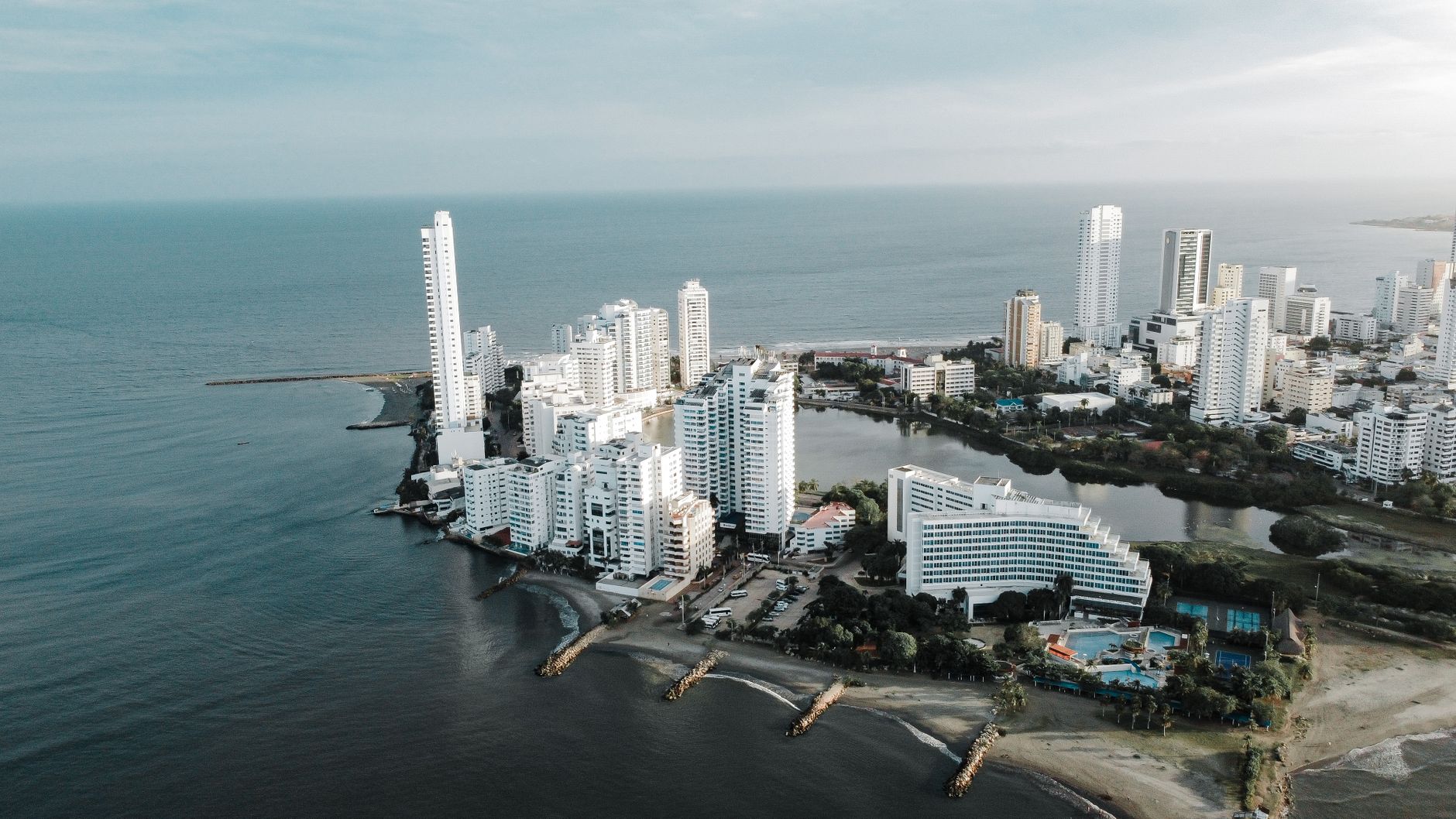
The first consolidated stretch of the Zona Norte: gated tower complexes along the road, beach in front and their own amenities. Almost everything is high-rise condominium, much of it bought as a second home and rented out seasonally. It sits minutes from the airport along the Anillo Vial, which is its only real way in and out.
- what the condominium bylaws say about daily rentals, because several complexes restrict them and buyers find out after signing
- the state of the maintenance dues and the reserve fund, which in seafront buildings goes into façade upkeep
- whether the tower holds a concession or permit for the beach in front, which does not come with the apartment
What to verify, step by step
- Ask the curaduría urbana for the urban-rules opinion on the property in Morros, the document that states ratios, setbacks and height.
- Identify the lot's treatment and polygon in the POT before commissioning any design, and ask whether it falls in protected land.
- Compare the IGAC area and boundaries against the deed: the rules apply to the real area, not the one in the listing.
- Ask Aeronáutica Civil whether the property sits under an aviation easement, the height restriction that surprises buyers most along this coast.
- Ask Cardique about water setbacks, mangrove or wetland, and DIMAR about the tidal strip if the lot fronts the sea, before counting on that strip.
- Ask to be told which condition specific to Morros the design would have to resolve, and request it in writing from whoever imposes it.
Mistakes that cost money
- Buying the lot and researching the rules afterwards. The order is the other way round, and the rules opinion can be obtained before signing.
- Assuming what stands next door is the ceiling of what is allowed. The neighbour may have built under earlier rules, or may have built without complying with them.
- Treating the whole deeded area as buildable. Between setbacks, contributions and constraints, what can be occupied is less, and how much less is for the curaduría to say.
Frequently asked questions
- Where do I ask for the ratios and height for my lot?
- At the curaduría urbana, for that specific property, with the POT as the underlying source. An article cannot give you those values without getting them wrong.
- Does a listing that says 'suitable for a tower' bind anyone?
- No. What determines what can be built is the property's rules and the permit, not the wording of the advertisement.
- Can I request all of this from abroad?
- Yes, in writing. The curaduría, IGAC, Cardique and Aeronáutica Civil all handle requests without you being in the city.
Where to check it
- Curadurías Urbanas de Cartagena — whether a current building or subdivision permit exists and exactly what it authorises
- Plan de Ordenamiento Territorial de Cartagena — land use, the rules applying to the property and protected land
- Instituto Geográfico Agustín Codazzi — the cadastral record, area, boundaries and assessed value of the property
- Cardique, autoridad ambiental del Canal del Dique — environmental permits, water setbacks and mangrove or wetland constraints
- Dirección General Marítima (DIMAR) — public-domain tidal land and concessions over the beach
- Aeronáutica Civil — works at Rafael Núñez airport and the aviation easements that cap building height
- Alcaldía Mayor de Cartagena de Indias — property tax, betterment levies and District procedures
- Superintendencia de Notariado y Registro — the certificate of title and encumbrances, which is the property's full history
- Cartagena de Indias — the rules of the municipality Morros belongs to
Official bodies. Specific figures are requested there, not copied from a listing.
Updated 2026-11-05
More about Morros
- Cartagena's land-use plan applied to Morros: use, protection and limits
- Property tax and betterment levies in Morros: the debt that follows the property
- Seasons and demand in Morros: how to ask for the data instead of believing it
- The reglamento de propiedad horizontal in Morros: why it governs inside the building
- Administration dues and the reserve fund in Morros: what they actually cover
The same, in other neighbourhoods
Interested in a property in this area?
Write to us and we will send you the available options.