In Castillogrande the path you walk down to the sea rarely belongs to the property being sold. It crosses someone else's land, public-domain land, or rests on a verbal arrangement between neighbours — and each of the three is verified differently.
The beach and the tidal strip are public domain, so the right to be on the sand is not the issue: getting there is. Access that actually holds is access constituted as a servidumbre — an easement — and recorded on the registry folio of the burdened property, because only then does it survive the neighbour selling, building, or locking the gate. A path tolerated for years is not a recorded right, and when it closes the buyer discovers that a seafront property now depends on litigation. That shows up in the price, in the ability to rent, and in whether a bank will accept the property as collateral.
In Castillogrande the typical deal is not a unit in a condominium but a house and its lot, which puts the weight of the file back on the chain of title to the land: you climb through the deeds to the parcelación, the original subdivision that created the block, because those platting deeds registered conditions, setbacks and easements that still bind and that are invisible from the street. There is no building manager to issue a paz y salvo, a no-arrears certificate, and no assembly to settle anything, so boundary questions with a neighbor are argued between private parties and what governs is the title and the survey, not a set of house rules. The counterparty is usually an old city family and, fairly often, a family company that owns the property: then you must decide whether to buy the real estate or the company's shares, two different transactions with different paperwork and different exposure, and request the certificado de existencia y representación, the corporate good-standing and signing-authority certificate, together with the resolution approving the sale. And because the neighborhood is fully built out, any construction is permitted on an already developed lot, with neighbors entitled to take part in the proceeding.
What is specific to Castillogrande
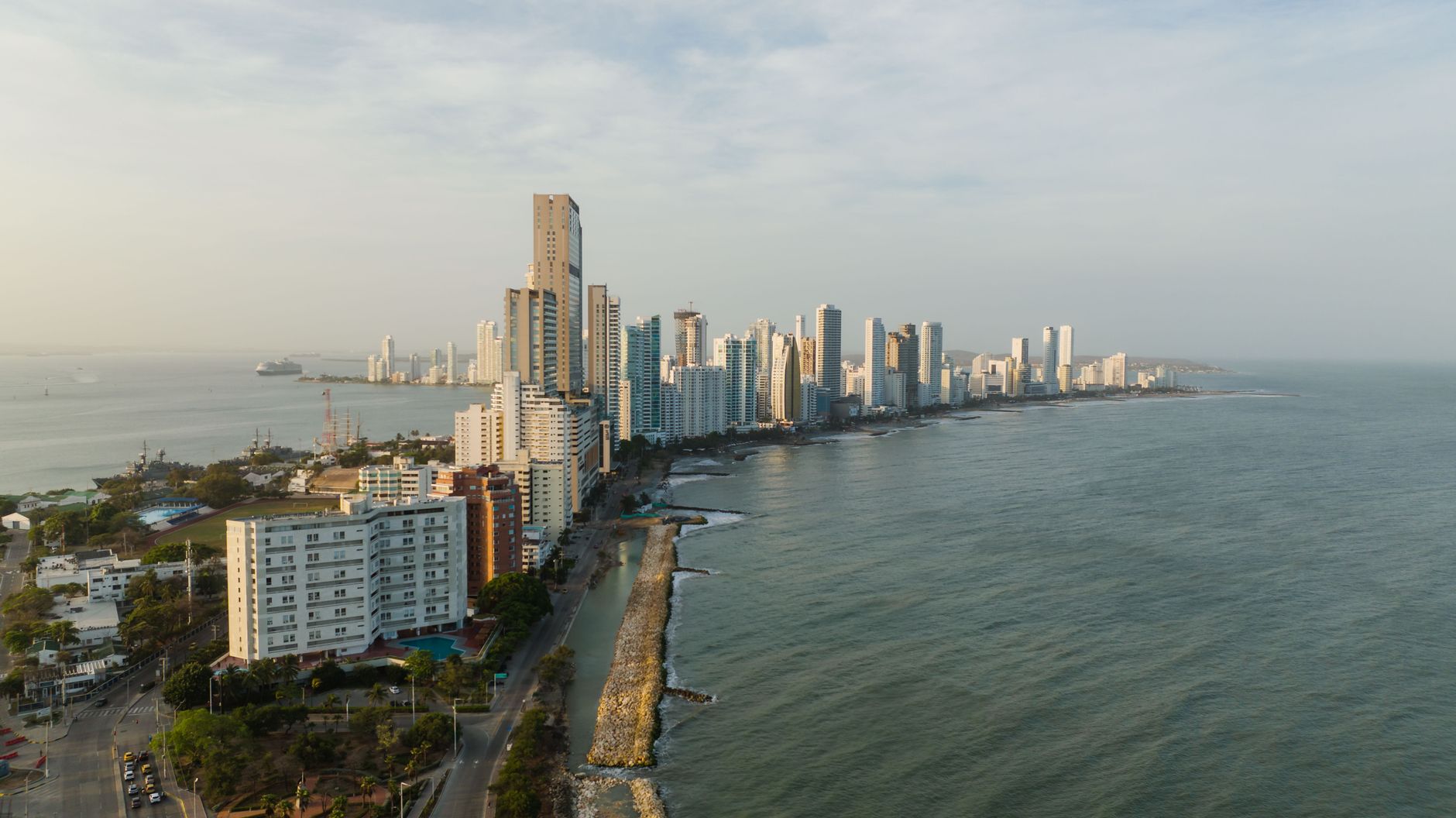
The residential tip of the peninsula: lower and quieter than Bocagrande, facing the bay, with little street retail. Houses and low-rise buildings sit alongside new towers, and single-family homes still exist. It is a dead end: access is through Bocagrande with no through road at the far tip, which keeps it free of passing traffic.
- whether the property faces the bay or the open sea, because the swell, the smell and the façade upkeep are not comparable
- what building height the rules allow on the lot, which is not uniform across the peninsula and is the first fact omitted when a lot is sold
- how ground stability was addressed, given this is land reclaimed from the sea, and what the soil study for the building says
What to verify, step by step
- Order the certificado de tradición y libertad for the property being sold and also for the property the access crosses. A servidumbre leaves a trace on both folios: as a right on one, as an encumbrance on the other.
- Ask the seller for the deed that created the easement and request it in full. If the answer is that “people have always walked through there”, that is an answer and worth writing down.
- Compare the path's actual route against the boundaries on the IGAC cadastral record, to establish which properties it really crosses.
- Check the POT for whether a public road or access is planned within the Castillogrande polygon, and whether the developer was left with an obligation to deliver it.
- Search the Rama Judicial for pending proceedings between adjoining owners — that is where access disputes surface, well before anyone mentions them on a site visit.
- If the path leads down to the beach, ask DIMAR whether that stretch carries a concesión or an authorised closure, because access can be restricted without any neighbour being at fault.
Mistakes that cost money
- Assuming a front-row property comes with its own access. Along this coast the seafront strip is public and the way through to it is what gets negotiated.
- Accepting an easement agreed in the promise of sale without checking it is recorded on the burdened property's folio. What is not recorded does not bind a later purchaser of that land.
- Assuming the complex's gatehouse settles it. Beach access through a complex depends on the condominium bylaws and, where a concession exists, on the maritime authority.
Frequently asked questions
- If the beach is public, how can I lack access?
- Because the beach being public does not create a path across private land. What grants passage is a recorded servidumbre or a public road, and that is checked on the register and in the POT.
- Is a signed agreement with the neighbour enough?
- It binds whoever signed it. For it to run with the property when the neighbour sells, it has to be constituted and recorded; ask for the deed and for the folio.
- Where are access disputes most common?
- Wherever an undeveloped lot sits between the road and the sea, as in Manzanillo del Mar and the still-open stretches of Cielo Mar and Punta Canoa. In Castillogrande the question is the same, asked with both properties' certificates in hand.
Where to check it
- Superintendencia de Notariado y Registro — the certificate of title and encumbrances, which is the property's full history
- Ventanilla Única de Registro (VUR) — checking the registry folio online and ordering the certificate without visiting the office
- Instituto Geográfico Agustín Codazzi — the cadastral record, area, boundaries and assessed value of the property
- Plan de Ordenamiento Territorial de Cartagena — land use, the rules applying to the property and protected land
- Rama Judicial — whether there is pending litigation over the property or its owners
- Dirección General Marítima (DIMAR) — public-domain tidal land and concessions over the beach
- Cartagena de Indias — the rules of the municipality Castillogrande belongs to
Official bodies. Specific figures are requested there, not copied from a listing.
Updated 2026-11-05
More about Castillogrande
- Coastal erosion in Castillogrande: where the data lives and what it means for building on the front row
- Mangrove, ronda hídrica and wetland in Castillogrande: why a protected lot does not develop like the rest
- Maintaining a seafront property in Castillogrande: what to ask the building manager before signing
- Beachfront apartment in Castillogrande: what changes versus being a few blocks back
- Penthouse and terrace in Castillogrande: what is yours and what is common property assigned for exclusive use
The same, in other neighbourhoods
- Beach access in Crespo: the right of way the seller shows you and the one that exists on the register
- Beach access in El Laguito: the right of way the seller shows you and the one that exists on the register
- Beach access in Barceloneta: the right of way the seller shows you and the one that exists on the register
- Beach access in La Boquilla: the right of way the seller shows you and the one that exists on the register
Interested in a property in this area?
Write to us and we will send you the available options.