Mangrove is protected, and the ronda hídrica — the protective strip around a body of water — is not buildable land by default. A lot in Castillogrande with mangrove or a wetland edge is permitted and valued differently, and that is something you establish before signing or not at all.
Two adjoining lots of the same size can have entirely different development capacity if one carries mangrove cover or falls inside the ronda hídrica. The environmental authority has to rule, intervening requires a permit, and the protected area does not count toward what is buildable: a buyer who pays for gross area and later discovers that part of it is protected land has paid for something unusable. Add to that the fact that clearing mangrove without a permit leaves consequences falling on whoever owns the land at the time, not on whoever cut it.
In Castillogrande the typical deal is not a unit in a condominium but a house and its lot, which puts the weight of the file back on the chain of title to the land: you climb through the deeds to the parcelación, the original subdivision that created the block, because those platting deeds registered conditions, setbacks and easements that still bind and that are invisible from the street. There is no building manager to issue a paz y salvo, a no-arrears certificate, and no assembly to settle anything, so boundary questions with a neighbor are argued between private parties and what governs is the title and the survey, not a set of house rules. The counterparty is usually an old city family and, fairly often, a family company that owns the property: then you must decide whether to buy the real estate or the company's shares, two different transactions with different paperwork and different exposure, and request the certificado de existencia y representación, the corporate good-standing and signing-authority certificate, together with the resolution approving the sale. And because the neighborhood is fully built out, any construction is permitted on an already developed lot, with neighbors entitled to take part in the proceeding.
What is specific to Castillogrande
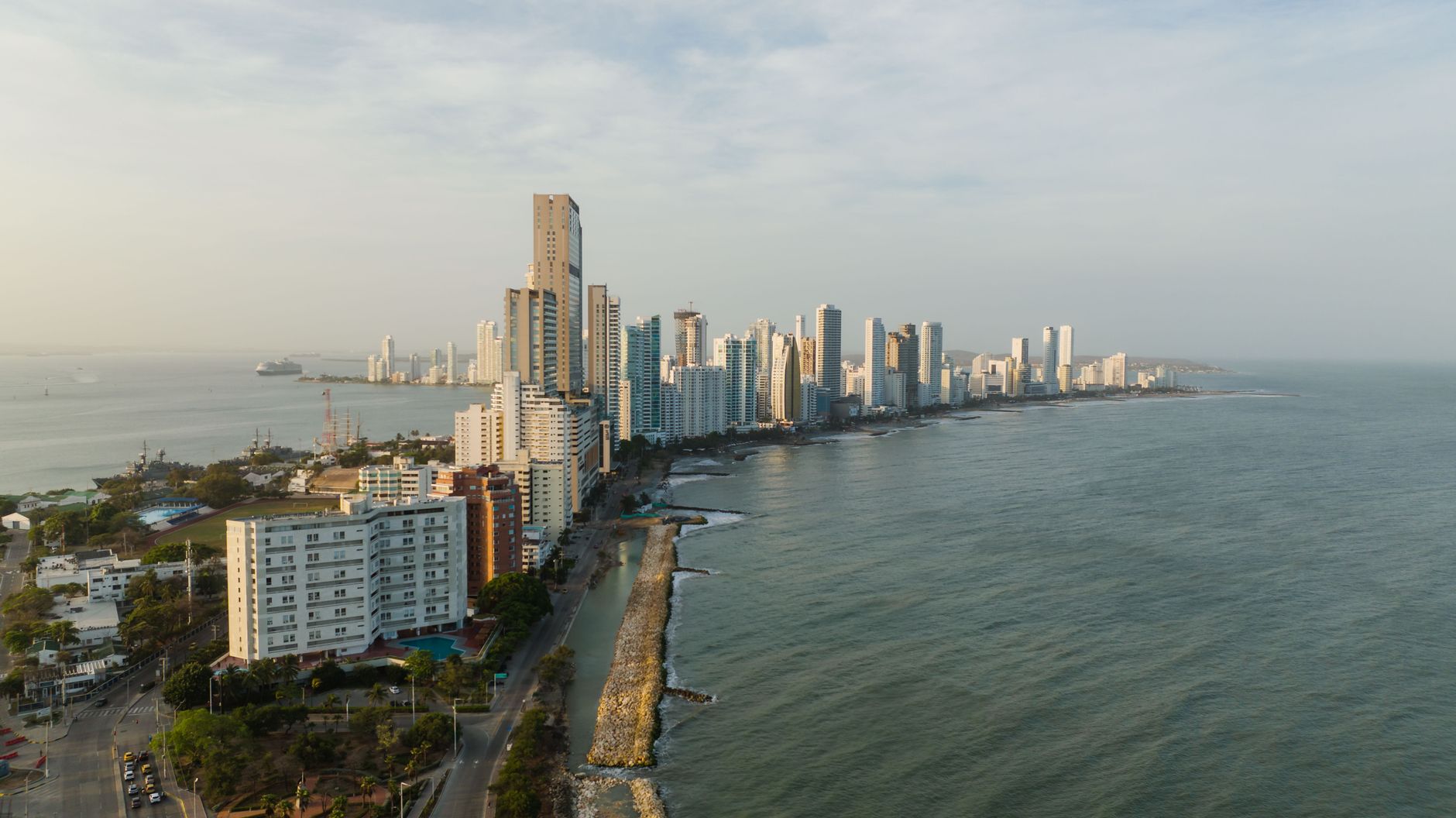
The residential tip of the peninsula: lower and quieter than Bocagrande, facing the bay, with little street retail. Houses and low-rise buildings sit alongside new towers, and single-family homes still exist. It is a dead end: access is through Bocagrande with no through road at the far tip, which keeps it free of passing traffic.
- whether the property faces the bay or the open sea, because the swell, the smell and the façade upkeep are not comparable
- what building height the rules allow on the lot, which is not uniform across the peninsula and is the first fact omitted when a lot is sold
- how ground stability was addressed, given this is land reclaimed from the sea, and what the soil study for the building says
What to verify, step by step
- Ask Cardique, the environmental authority, for a determination on the Castillogrande property: mangrove cover, ronda hídrica, permits granted, and any open enforcement proceedings. The request is in writing and leaves a record.
- Check the POT for the polygon's classification and how much area is protected land, and ask to have it marked on the property's plan rather than described in the abstract.
- Compare the area being sold against the area actually buildable once protection is deducted. Ask the seller for that calculation in writing.
- Ask whether there has been earlier filling, channelling or clearing on the lot and whether it was permitted, because an environmental liability follows the property, not the seller.
- Check in addition what has to be looked at in Castillogrande and not in the sector next door: whether the property faces the bay or the open sea, because the swell, the smell and the façade upkeep are not comparable; what building height the rules allow on the lot, which is not uniform across the peninsula and is the first fact omitted when a lot is sold and how ground stability was addressed, given this is land reclaimed from the sea, and what the soil study for the building says.
Mistakes that cost money
- Paying for the lot's gross area without knowing how much is protected land. It is the mistake of someone buying a lot on a wetland edge, and it is not fixed after the deed is signed.
- Believing that filling already carried out legalises the situation. Whoever buys apparently solid ground inherits both the fill and the file: unpermitted prior work does not improve the property, it adds an open matter with the environmental authority.
- Assuming that because the neighbour built, you can too. Development capacity is determined property by property and decided by the authority, not by the block.
Frequently asked questions
- Can mangrove be cleared with a permit?
- Intervening in mangrove is subject to authorisation by the environmental authority and is never assumed. The right step is to ask Cardique what is authorised on that property, not to estimate what might be authorisable.
- How wide is the ronda hídrica?
- It is a protective strip set by the environmental authority according to the body of water and the applicable administrative act. We publish no measurements here: ask Cardique for the figure for your property.
- Which sectors have a wetland edge?
- La Boquilla sits between the sea and the Ciénaga de la Virgen, and Serena del Mar adjoins the Juan Gómez wetland. If Castillogrande is one of them, the environmental enquiry is not optional but part of the review.
Where to check it
- Cardique, autoridad ambiental del Canal del Dique — environmental permits, water setbacks and mangrove or wetland constraints
- Plan de Ordenamiento Territorial de Cartagena — land use, the rules applying to the property and protected land
- Curadurías Urbanas de Cartagena — whether a current building or subdivision permit exists and exactly what it authorises
- Instituto Geográfico Agustín Codazzi — the cadastral record, area, boundaries and assessed value of the property
- Superintendencia de Notariado y Registro — the certificate of title and encumbrances, which is the property's full history
- Alcaldía Mayor de Cartagena de Indias — property tax, betterment levies and District procedures
- Cartagena de Indias — the rules of the municipality Castillogrande belongs to
Official bodies. Specific figures are requested there, not copied from a listing.
Updated 2026-11-05
More about Castillogrande
- Maintaining a seafront property in Castillogrande: what to ask the building manager before signing
- Beachfront apartment in Castillogrande: what changes versus being a few blocks back
- Penthouse and terrace in Castillogrande: what is yours and what is common property assigned for exclusive use
- House in a gated community in Castillogrande: what you are actually buying
- Buying land to build in Castillogrande: your own registry folio, utilities and planning rules
The same, in other neighbourhoods
- Mangrove, ronda hídrica and wetland in Crespo: why a protected lot does not develop like the rest
- Mangrove, ronda hídrica and wetland in El Laguito: why a protected lot does not develop like the rest
- Mangrove, ronda hídrica and wetland in Barceloneta: why a protected lot does not develop like the rest
- Mangrove, ronda hídrica and wetland in La Boquilla: why a protected lot does not develop like the rest
Interested in a property in this area?
Write to us and we will send you the available options.