A lot in Bocagrande is not worth what it measures but what the rules let you put on it, and that fact is never in the listing. Lot sellers rarely mention it, because it is precisely what shrinks the project you had in mind.
Every property carries an occupancy ratio and a floor-area ratio, setbacks from neighbours and from the road, a maximum height, a required number of parking spaces and mandatory land contributions. Those parameters are not citywide: they come from the treatment and polygon the POT (the city's land-use plan) assigns to that property, and they are fixed when the curaduría urbana issues the permit. In the Zona Norte further constraints stack on top and none of them shows on a survey: aviation easements capping height near the airport, water setbacks and mangrove where Cardique has a say, public-domain land where DIMAR does. We publish none of those values, because the only ones that matter are the ones the curaduría certifies for your lot.
Bocagrande works like a mature resale market, with consequences that do not repeat up north. The counterparty is almost never a builder: it is a long-standing owner or, very often, an unsettled sucesión, an estate proceeding, whose heirs live in different countries, so closing depends not on one power of attorney but on several, and on the partition among them. The registry record is old too: it was opened when the building was submitted to the condominium regime, it carries legacy entries such as cancelled mortgages, patrimonio de familia and afectación a vivienda familiar, both family-home protections, or lifted attachments, and the recorded area does not always match a current survey, so you compare the registry record against the deed and against the unit's floor plan. The peninsula is also land reclaimed from the sea under subdivisions the District authorized in their day, and the oldest deeds still carry references to those parcelaciones, the original platting. Day-to-day power sits with the owners' assembly and its manager, so in a tower with a long record of decisions the minutes and the status of the condominium's lawsuits matter more than the brochure.
What is specific to Bocagrande
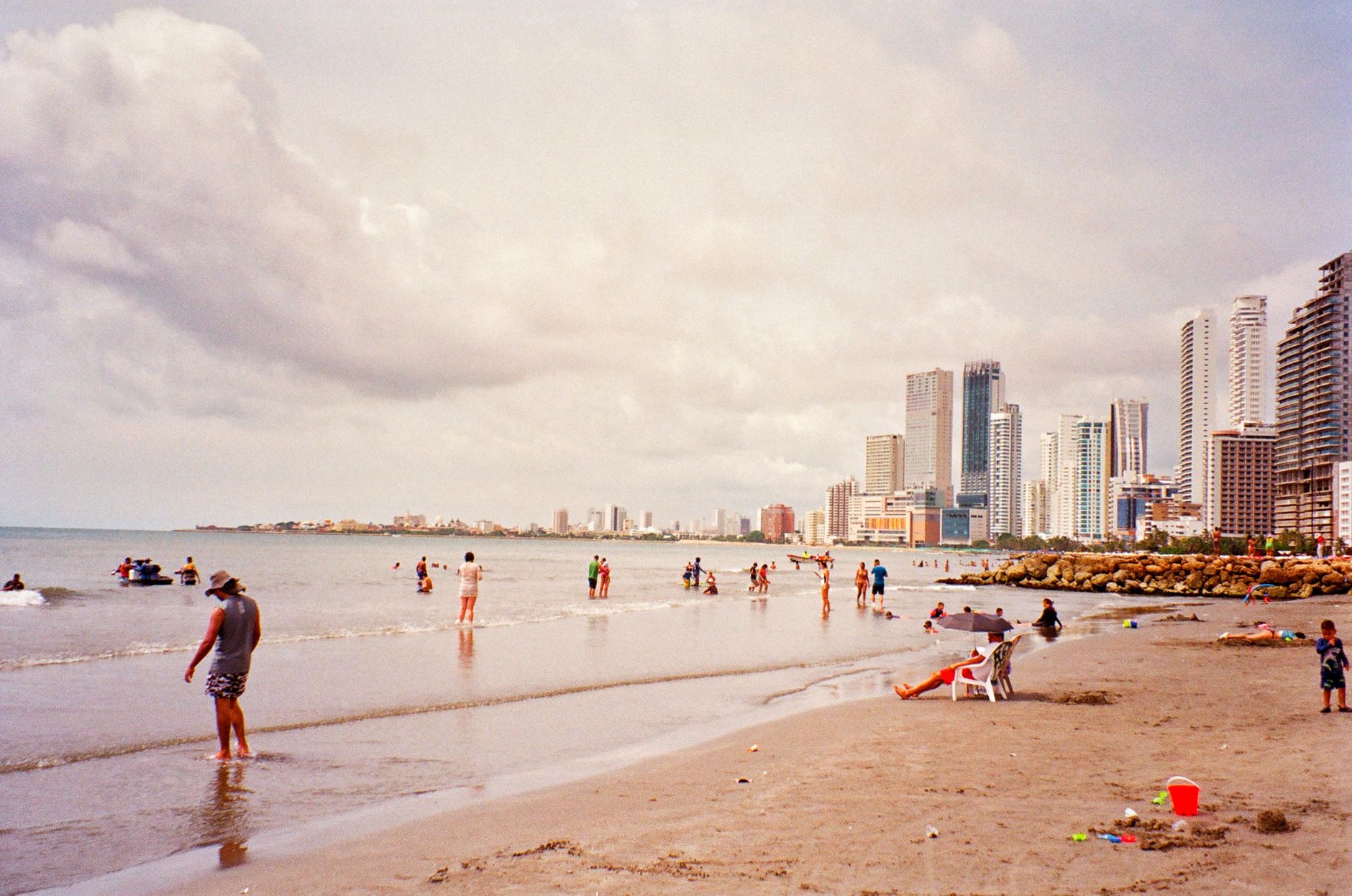
Cartagena's dense, vertical peninsula: open sea on one side, bay on the other, and built out to the last lot. Condominium towers from very different eras, from the sixties to recent construction, on the same block. Groceries, restaurants and beach are walkable, and access is through a few roads that saturate in high season.
- the building's actual age and whether it has a structural vulnerability study, since much of the stock was built under seismic codes earlier than those now in force
- what the condominium bylaws say about daily rentals, which on this peninsula is the difference between being able to rent and not
- how many parking spaces the unit holds in the deed, not in the brochure, because older towers do not have one per apartment
What to verify, step by step
- Ask the curaduría urbana for the urban-rules opinion on the property in Bocagrande, the document that states ratios, setbacks and height.
- Identify the lot's treatment and polygon in the POT before commissioning any design, and ask whether it falls in protected land.
- Compare the IGAC area and boundaries against the deed: the rules apply to the real area, not the one in the listing.
- Ask Aeronáutica Civil whether the property sits under an aviation easement, the height restriction that surprises buyers most along this coast.
- Ask Cardique about water setbacks, mangrove or wetland, and DIMAR about the tidal strip if the lot fronts the sea, before counting on that strip.
- Ask to be told which condition specific to Bocagrande the design would have to resolve, and request it in writing from whoever imposes it.
Mistakes that cost money
- Buying the lot and researching the rules afterwards. The order is the other way round, and the rules opinion can be obtained before signing.
- Assuming what stands next door is the ceiling of what is allowed. The neighbour may have built under earlier rules, or may have built without complying with them.
- Treating the whole deeded area as buildable. Between setbacks, contributions and constraints, what can be occupied is less, and how much less is for the curaduría to say.
Frequently asked questions
- Where do I ask for the ratios and height for my lot?
- At the curaduría urbana, for that specific property, with the POT as the underlying source. An article cannot give you those values without getting them wrong.
- Does a listing that says 'suitable for a tower' bind anyone?
- No. What determines what can be built is the property's rules and the permit, not the wording of the advertisement.
- Can I request all of this from abroad?
- Yes, in writing. The curaduría, IGAC, Cardique and Aeronáutica Civil all handle requests without you being in the city.
Where to check it
- Curadurías Urbanas de Cartagena — whether a current building or subdivision permit exists and exactly what it authorises
- Plan de Ordenamiento Territorial de Cartagena — land use, the rules applying to the property and protected land
- Instituto Geográfico Agustín Codazzi — the cadastral record, area, boundaries and assessed value of the property
- Cardique, autoridad ambiental del Canal del Dique — environmental permits, water setbacks and mangrove or wetland constraints
- Dirección General Marítima (DIMAR) — public-domain tidal land and concessions over the beach
- Aeronáutica Civil — works at Rafael Núñez airport and the aviation easements that cap building height
- Alcaldía Mayor de Cartagena de Indias — property tax, betterment levies and District procedures
- Superintendencia de Notariado y Registro — the certificate of title and encumbrances, which is the property's full history
- Cartagena de Indias — the rules of the municipality Bocagrande belongs to
Official bodies. Specific figures are requested there, not copied from a listing.
Updated 2026-11-05
More about Bocagrande
- Cartagena's land-use plan applied to Bocagrande: use, protection and limits
- Property tax and betterment levies in Bocagrande: the debt that follows the property
- Seasons and demand in Bocagrande: how to ask for the data instead of believing it
- The reglamento de propiedad horizontal in Bocagrande: why it governs inside the building
- Administration dues and the reserve fund in Bocagrande: what they actually cover
The same, in other neighbourhoods
Interested in a property in this area?
Write to us and we will send you the available options.