Between the reservation and the deed of a retail unit there is a chain of payments, and each one needs an identified recipient and a document behind it. Whatever that chain fails to record is what later cannot be claimed or proved.
A payment schedule is not just a calendar: it answers three questions that decide money. Who the money is paid to, because paying the sales agent, an individual, or an account that appears nowhere in the signed document leaves the buyer with no claim against whoever is actually selling. What document supports each payment, because a cash receipt does not say which obligation it is applied against, and that application is precisely what gets argued when something breaks. And under what structure the money is held, because a finished retail unit and one still to be built are neither paid for the same way nor held by the same third party. When the buyer wires from abroad, the trail of the transfer is added: the bank and the Banco de la República record how the funds came in, and that record is what gets asked for when selling or sending funds back out. What applies to your case is a question for your bank, the fiduciaria and your attorney, not something to infer from a brochure.
A retail unit is bought differently because you are not buying a space but the possibility that someone can trade in it, and that possibility is granted by third parties. Two permissions are needed and nobody bundles them: the one the land-use rules give for that specific lot, and the one the copropiedad's reglamento gives, which need not agree. On top of those sit the tenant's own business permits, applied for activity by activity. The second difference is the relationship with the tenant. A lease of premises for commercial purposes runs under rules distinct from residential tenancies, with an expectation of continuity for the tenant that is worth having a lawyer spell out before signing, because the buyer steps into a contract that already exists and inherits its history. The third is that the unit depends on what lies outside it: façade, signage, pavement, loading area and public access are normally bien común, common property, or public space. What makes the unit profitable, in other words, is not inside its walls and is not decided from within the unit.
What you buy in Morros is not land but a private unit created by subdividing a single folio matriz, the parent registry record, and that changes the file. The chain of title on the land was settled once by the builder; what remains to review is the registered reglamento de propiedad horizontal, the condominium bylaws, any acta de asamblea, owners' meeting minutes, that amended them, and the coeficiente de copropiedad, the ownership share assigned to the unit, which governs both voting and billing. The counterparty differs from the undeveloped north as well: usually an individual owner living outside Cartagena, so closing depends on a power of attorney from that person, on a spouse's consent where it applies, and on the paz y salvo, a no-arrears certificate signed by the building manager, a document that does not even exist for rural land. Decisions here belong to the owners' assembly and the manager it appoints, not to a public office; the District and the curaduría urbana, the private licensing office, had their say when the tower was permitted. Internal infrastructure, from pumping to the generator and security, is private and funded by the budget that same assembly approves, so the minutes describe the property better than any tour.
What is specific to Morros
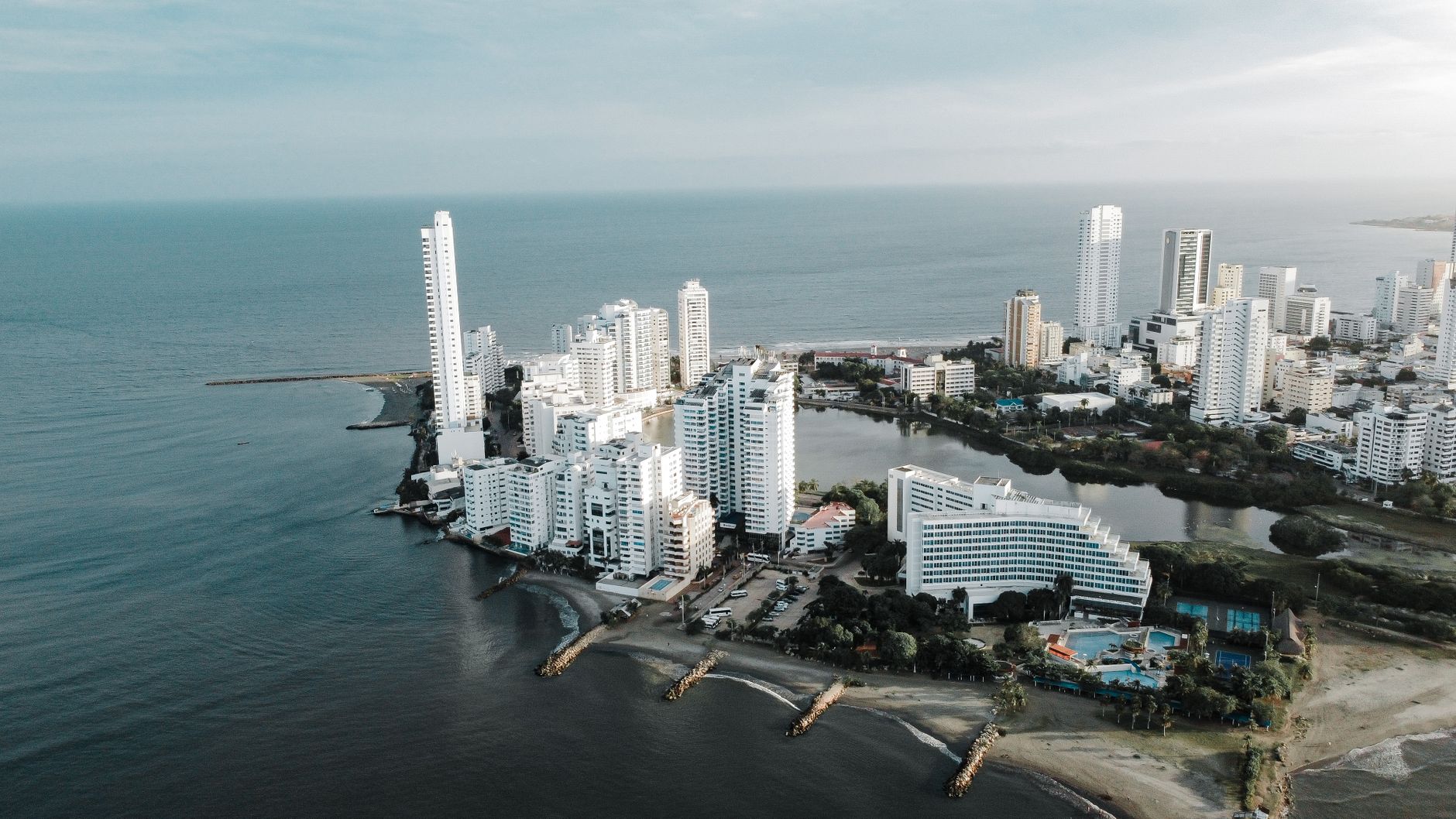
The first consolidated stretch of the Zona Norte: gated tower complexes along the road, beach in front and their own amenities. Almost everything is high-rise condominium, much of it bought as a second home and rented out seasonally. It sits minutes from the airport along the Anillo Vial, which is its only real way in and out.
- what the condominium bylaws say about daily rentals, because several complexes restrict them and buyers find out after signing
- the state of the maintenance dues and the reserve fund, which in seafront buildings goes into façade upkeep
- whether the tower holds a concession or permit for the beach in front, which does not come with the apartment
What to verify, step by step
- Ask in writing for the full payment schedule showing the name, tax identifier and bank account of the recipient of every instalment, and confirm that recipient is the same party signing the document.
- Require each payment to be applied against an obligation in the signed document, with the receipt stating which item it covers and over which property.
- Ask whether what you are signing is a promesa de compraventa, a reservation or a deposit instruction, because that decides what delivery you are buying and from whom.
- Check what belongs to a retail unit itself and shapes how its payments are structured: whether the POT (the city's land-use plan) allows commercial use on that specific lot and whether the reglamento de propiedad horizontal admits it — two separate permissions, and you need both; whether the particular activity planned requires a concepto de uso de suelo (a land-use ruling) and who applies for it, owner or tenant and how façade, signage, pavement and loading area are allocated, since these are usually bien común even though the unit uses them daily.
- If you are wiring from outside Colombia, ask your bank and the Banco de la República what record the operation leaves, and keep a copy of every transfer document naming the property.
- Before the deed, order the updated folio from the Oficina de Registro and compare the registered owner against the recipient you have been paying.
Mistakes that cost money
- Wiring to an account sent to you by message. The valid account is the one in the signed document, and a change of account is confirmed through the company's own channel, never through the message that requested it.
- Accepting receipts with no application stated. A receipt that says only «payment on account» proves nothing about which obligation was paid when more than one document is in play.
- Leaving the transfer trail to be assembled at the end. Reconstructing later how each instalment came in is harder than asking for the document on the day.
Frequently asked questions
- Can the down payment be wired to the seller as an individual?
- That depends on who appears as seller in the signed document and on the folio. Compare the two and ask your attorney what record each option leaves before you wire.
- What role does the fiduciaria play in the payment schedule?
- Where funds are received through a patrimonio autónomo (a trust estate), the fiduciaria holds the money and can certify what you paid in. Ask it for that certificate, not only the seller.
- Can I pay from an account that is not in my name?
- That is a decision with banking and tax consequences, answered by your bank and your adviser rather than the seller. What does help is that the signing buyer and the account holder both appear on the supporting document.
Where to check it
- Superintendencia Financiera de Colombia — whether a trust company exists and is supervised, before transferring money to a patrimonio autónomo
- Banco de la República — registration of foreign investment and the official exchange rate
- Superintendencia de Notariado y Registro — the certificate of title and encumbrances, which is the property's full history
- Cartagena de Indias — the rules of the municipality Morros belongs to
Official bodies. Specific figures are requested there, not copied from a listing.
Updated 2026-11-06
Interested in a property in this area?
Write to us and we will send you the available options.