The deed identifies the buyer by a number, and a foreign passport is not always the number the paperwork expects. A buyer from Medellín who reaches the signing without having sorted out their Colombian tax identification finds the date slipping, and not over price.
Two things get conflated here. The RUT is the tax registry held by the DIAN, and the NIT is the number that registry assigns to someone without a Colombian cédula; together they are the identity under which you exist for tax purposes and under which the property's tax and any future sale are settled. The cédula de extranjería (foreigner ID card) and a visa are a different matter and a different authority. What decides money is the sequence: whoever appears on the escritura, whoever sends the funds and whoever holds the tax identification have to be the same party, and fixing a mismatch after recording is a separate procedure. The DIAN states which documents from each country it accepts and in what form, the Cancillería explains apostille and legalisation of those documents, and the notaría states which identification it will draw the deed with.
The mortgage is requested from a Colombian bank, which studies it against the buyer's local credit history rather than against collateral abroad or seller financing: they ask for proof of income, check the centrales de riesgo, the credit bureaus, and order the avalúo, the appraisal, and the title study of the Cartagena property. There is one concrete question worth asking here: in which city the approval is decided, because the file is usually opened at the branch in your own city and then escalated elsewhere inside the bank, and whoever answers for the yes or the no is the mortgage department, not the adviser in front of you. Ask in writing for the approval letter and the disbursement instructions, because each disbursement rests on a different document: the promesa de compraventa first, and the registered escritura with the mortgage recorded on it afterwards. The transfer does not pass through the regulated exchange market and there is no foreign investment to register with the Banco de la República; proof of the source of funds is still assembled, and that is a separate matter. You can fly in to sign, so no poder and no apostille, but you manage from a distance: settle who receives the property, who pays the predial and the building fee, and who issues the paz y salvo. Tax questions go to the DIAN and to an accountant.
In Castillogrande the typical deal is not a unit in a condominium but a house and its lot, which puts the weight of the file back on the chain of title to the land: you climb through the deeds to the parcelación, the original subdivision that created the block, because those platting deeds registered conditions, setbacks and easements that still bind and that are invisible from the street. There is no building manager to issue a paz y salvo, a no-arrears certificate, and no assembly to settle anything, so boundary questions with a neighbor are argued between private parties and what governs is the title and the survey, not a set of house rules. The counterparty is usually an old city family and, fairly often, a family company that owns the property: then you must decide whether to buy the real estate or the company's shares, two different transactions with different paperwork and different exposure, and request the certificado de existencia y representación, the corporate good-standing and signing-authority certificate, together with the resolution approving the sale. And because the neighborhood is fully built out, any construction is permitted on an already developed lot, with neighbors entitled to take part in the proceeding.
What is specific to Castillogrande
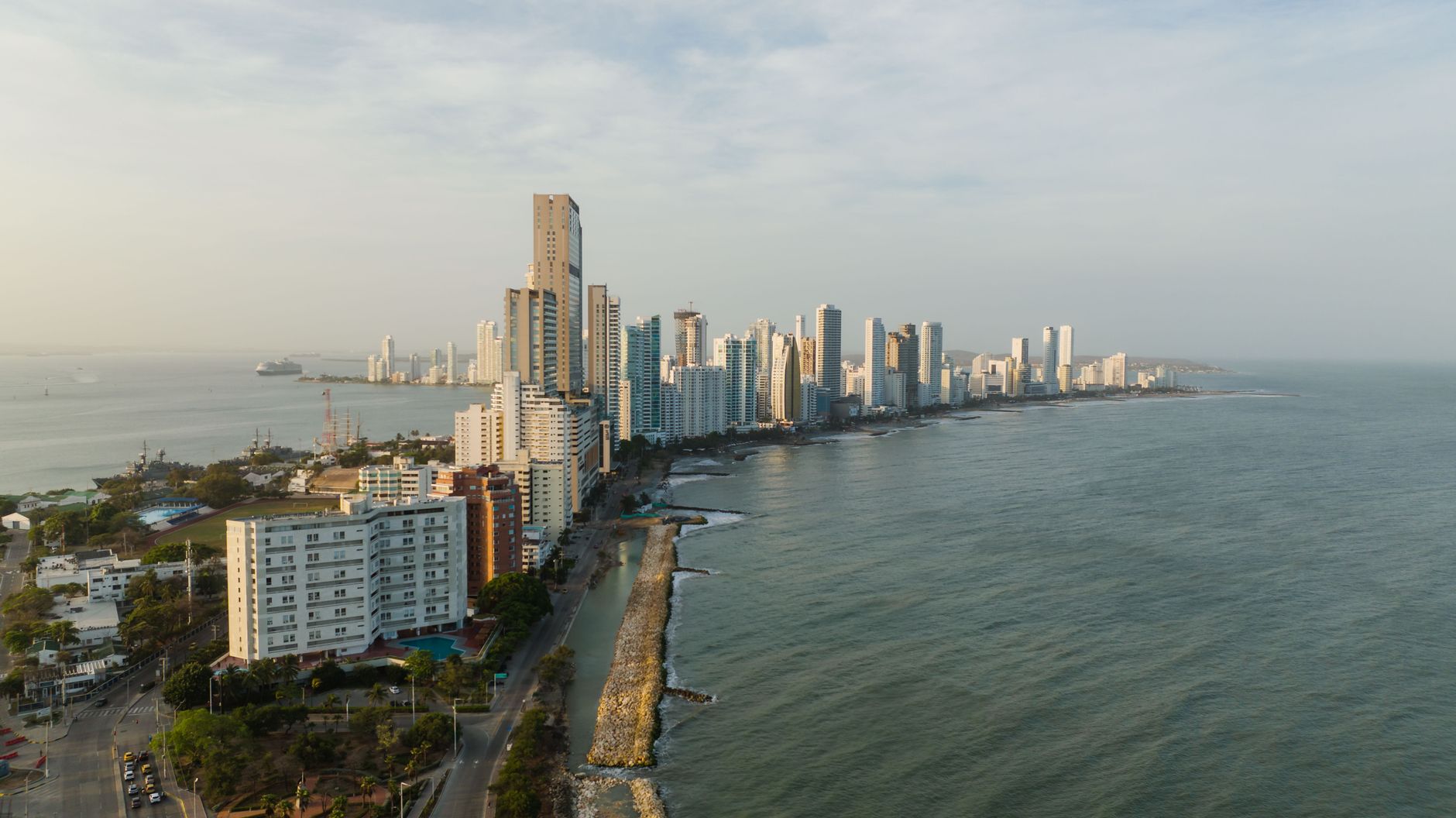
The residential tip of the peninsula: lower and quieter than Bocagrande, facing the bay, with little street retail. Houses and low-rise buildings sit alongside new towers, and single-family homes still exist. It is a dead end: access is through Bocagrande with no through road at the far tip, which keeps it free of passing traffic.
- whether the property faces the bay or the open sea, because the swell, the smell and the façade upkeep are not comparable
- what building height the rules allow on the lot, which is not uniform across the peninsula and is the first fact omitted when a lot is sold
- how ground stability was addressed, given this is land reclaimed from the sea, and what the soil study for the building says
What to verify, step by step
- Ask the DIAN which tax identification applies in your case in order to appear as the buyer, which documents from your country are required, in what form, and whether an attorney-in-fact may file. That answer comes from the DIAN, not from the broker.
- What a buyer from Medellín has to settle before opening the procedure: in which city the loan approval is decided and who answers for it, not only who opens your file; which document supports each disbursement, and what proof of source of funds the bank and the notaría want, which is not a foreign investment registration and who receives the property, who pays the predial and the building fee, and who issues the paz y salvo when you do not live in Cartagena.
- Check with the Cancillería which of your country's documents need an apostille or consular legalisation, and what official translation is required, since a document without that seal is sent back.
- Ask the notaría in Castillogrande which identification it will draw the deed with, and confirm that name and number match exactly those on the certificado de tradición y libertad and those on the transfer.
- If you will not be present, grant the poder before a Colombian consul or with an apostille, and ask the notaría and the Cancillería which of the two they accept before paying for the translation.
- Once the deed is recorded, check with the Superintendencia de Notariado y Registro that the buyer was entered under the same identification used to sign.
Mistakes that cost money
- Leaving the tax identification until last, once there is a signing date. It is the single formality that most often pushes the signing back for buyers abroad.
- Transferring from an account whose holder is not the buyer who will appear on the deed. Those two names have to match, and explaining it afterwards costs more than planning for it.
- Assuming the tax identification has anything to do with a visa or with residency. Different authorities, different procedures, and neither stands in for the other.
Frequently asked questions
- Can a buyer from Medellín complete this without travelling?
- That is the question to put to the DIAN for your specific case, along with whether an attorney-in-fact may file and which documents must be apostilled. We do not pre-empt the answer, because the requirements change.
- Do I need the foreigner ID card for this?
- That is a question for Migración Colombia, and it is separate from the tax one. The identification the deed is drawn with is confirmed by the notaría.
- Can I buy through a company from my own country?
- It can be put on the table, and it changes which identification and which documents are required. Settle it with the DIAN and with an accountant before signing the promesa, because afterwards the titleholder does not change without another deed.
Where to check it
- DIAN — the tax ID, withholding on sale and the capital gains tax
- Cancillería de Colombia — current visa requirements and the apostille of foreign documents
- Superintendencia de Notariado y Registro — the certificate of title and encumbrances, which is the property's full history
- Cartagena de Indias — the rules of the municipality Castillogrande belongs to
Official bodies. Specific figures are requested there, not copied from a listing.
Updated 2026-11-06
Interested in a property in this area?
Write to us and we will send you the available options.