Every property carries a recorded economic use in the cadastre, and the one attached to a house in a gated condominio is not always the use it actually serves. That line is no administrative detail: it is the basis on which property tax is assessed and the record checked whenever a permit is requested.
Economic use is the classification IGAC assigns to a property on its cadastral record —residential, commercial, vacant land, mixed— and it travels together with the area, the boundaries and the valuation. When the record says one thing and the property does another, the mismatch surfaces at three awkward moments: when the Distrito assesses property tax, when a ruling or a permit is applied for and the file does not line up, and when the buyer comes to sell and the title search compares the cadastral record against the registry folio. For a house in a gated condominio the mismatch has typical causes, and it is worth knowing which one is yours before signing, because the correction is filed with the cadastral authority and is not solved at the notaría on signing day. What classification your property carries and how it is corrected are questions for IGAC or the Distrito's cadastral authority; what it means for your taxes is one for your adviser.
A house in a gated condominio is bought differently because the home is individual while the small town around it is private. Roof, foundations and internal installations belong to the owner and the owner repairs them, no asamblea involved. But the road that reaches it, the water it receives, the lighting, the pool, the gatehouse and often the treatment plant belong to the development and are kept up by everyone's dues. Two questions follow, and they organize the purchase. The first is infrastructure: whether those networks were handed over to the Distrito, the city government, or remain private, because in the second case replacing a pipe or a stretch of road is paid by the copropiedad and not by the city. The second is autonomy: the house looks free-standing, yet extending it, repainting it another color, enclosing a terrace or changing the perimeter wall goes first through the condominio's reglamento and only afterwards to the planning authority, two separate processes with different criteria. For a buyer abroad, that means the home arrives livable while its surroundings are a shared account that stays open, and it pays to know which body decides what.
Bocagrande works like a mature resale market, with consequences that do not repeat up north. The counterparty is almost never a builder: it is a long-standing owner or, very often, an unsettled sucesión, an estate proceeding, whose heirs live in different countries, so closing depends not on one power of attorney but on several, and on the partition among them. The registry record is old too: it was opened when the building was submitted to the condominium regime, it carries legacy entries such as cancelled mortgages, patrimonio de familia and afectación a vivienda familiar, both family-home protections, or lifted attachments, and the recorded area does not always match a current survey, so you compare the registry record against the deed and against the unit's floor plan. The peninsula is also land reclaimed from the sea under subdivisions the District authorized in their day, and the oldest deeds still carry references to those parcelaciones, the original platting. Day-to-day power sits with the owners' assembly and its manager, so in a tower with a long record of decisions the minutes and the status of the condominium's lawsuits matter more than the brochure.
What is specific to Bocagrande
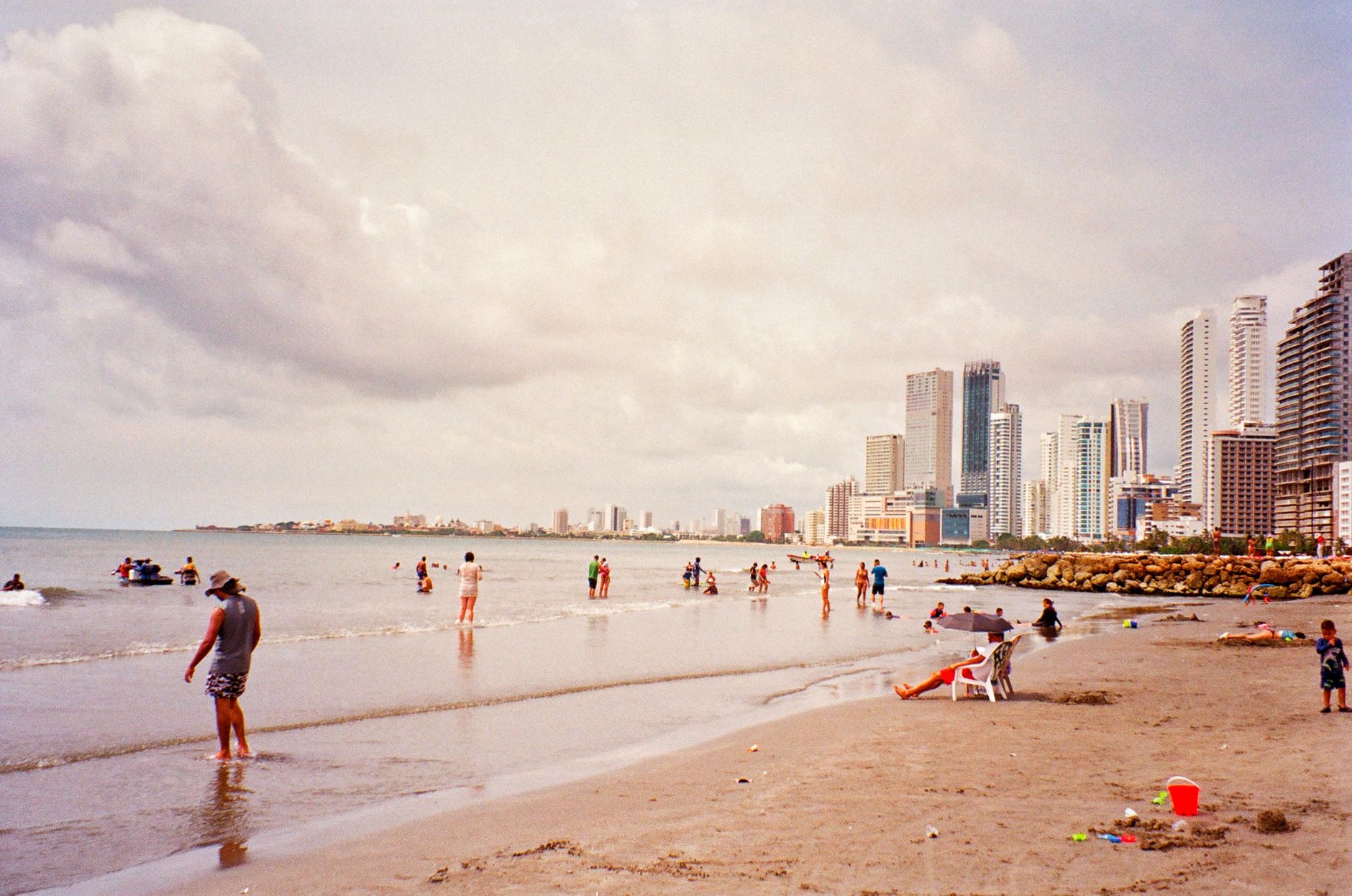
Cartagena's dense, vertical peninsula: open sea on one side, bay on the other, and built out to the last lot. Condominium towers from very different eras, from the sixties to recent construction, on the same block. Groceries, restaurants and beach are walkable, and access is through a few roads that saturate in high season.
- the building's actual age and whether it has a structural vulnerability study, since much of the stock was built under seismic codes earlier than those now in force
- what the condominium bylaws say about daily rentals, which on this peninsula is the difference between being able to rent and not
- how many parking spaces the unit holds in the deed, not in the brochure, because older towers do not have one per apartment
What to verify, step by step
- Order the property's cadastral record by its registry folio and read the recorded economic use, the built area and the land area exactly as they appear, not as the listing describes them.
- Compare that record against the certificado de tradición y libertad (the title and encumbrances certificate) from the Ventanilla Única de Registro: property identification, area and boundaries must tell the same story.
- Ask the Alcaldía which use the property tax is currently being assessed under, and since when.
- Check what belongs to a house in a gated condominio itself and explains why its record may not match: where the house's área privada ends and the common area begins, because garden, perimeter wall and front setback are not always the owner's; what the reglamento imposes on façade, extensions and fencing, which is the first thing a buyer wants to change and whether the internal roads, water line and treatment plant belong to the condominio or were handed over to the Distrito, since that decides who repairs them.
- Where there is a mismatch, ask the cadastral authority which correction or mutación application applies, who may file it and what supporting documents it takes; the filing starts without travelling, with a power of attorney where a signature is needed.
- Have the promesa state who files the correction, with what supporting documents, and what happens to closing if the cadastral authority has not yet ruled.
Mistakes that cost money
- Confusing cadastral use with POT land use. The POT says what is allowed in the polygon; the cadastre says how the property is classified, and you can be in order with one and not the other.
- Taking the record the seller hands you at face value. Order it yourself and recently dated, because a cadastral mutación changes the record without changing the deed.
- Assuming the correction is notarial business. The record is amended by the cadastral authority, and a deed does not take its place.
Frequently asked questions
- Where is the recorded economic use consulted?
- On the property's cadastral record, with IGAC or whichever cadastral authority operates in the municipality. The registry folio from the Ventanilla Única de Registro is used to cross-check it.
- Can a deed be signed while the recorded use is out of date?
- That is a question for the notary and your attorney, since it depends on what the particular transaction requires. What you can verify before signing is what the record says today and what filing is pending.
- Who is asked for the correction when the record does not match?
- The competent cadastral authority, which is what amends the record. The Alcaldía comes in for whatever affects the property tax assessment.
Where to check it
- Instituto Geográfico Agustín Codazzi — the cadastral record, area, boundaries and assessed value of the property
- Ventanilla Única de Registro (VUR) — checking the registry folio online and ordering the certificate without visiting the office
- Alcaldía Mayor de Cartagena de Indias — property tax, betterment levies and District procedures
- Cartagena de Indias — the rules of the municipality Bocagrande belongs to
Official bodies. Specific figures are requested there, not copied from a listing.
Updated 2026-11-06
Interested in a property in this area?
Write to us and we will send you the available options.