Water running on the day of the visit does not prove that availability has been certified, and the meter feeding a house in a gated condominio is not always registered to the property itself. These are two separate documents, issued by different bodies, and a buyer who asks for neither inherits whatever was never checked.
Service availability is evidenced by a certification from the utility company for that specific property, and it is the document the curaduría looks at when a permit is requested. A seller's word, a temporary hook-up or a line drawn from a neighbour are not the same thing, and the difference decides whether a house in a gated condominio can be lived in, conveyed or remodelled. Alongside that sits the bill: in Colombia utility balances follow the property rather than the person who ran them up, so the account status and the name recorded on the meter belong in the promesa de compraventa (the binding promise of sale) and not in an act of trust. How much is owed is for the utility to state; who pays it is what gets agreed in writing before signing.
A house in a gated condominio is bought differently because the home is individual while the small town around it is private. Roof, foundations and internal installations belong to the owner and the owner repairs them, no asamblea involved. But the road that reaches it, the water it receives, the lighting, the pool, the gatehouse and often the treatment plant belong to the development and are kept up by everyone's dues. Two questions follow, and they organize the purchase. The first is infrastructure: whether those networks were handed over to the Distrito, the city government, or remain private, because in the second case replacing a pipe or a stretch of road is paid by the copropiedad and not by the city. The second is autonomy: the house looks free-standing, yet extending it, repainting it another color, enclosing a terrace or changing the perimeter wall goes first through the condominio's reglamento and only afterwards to the planning authority, two separate processes with different criteria. For a buyer abroad, that means the home arrives livable while its surroundings are a shared account that stays open, and it pays to know which body decides what.
In Castillogrande the typical deal is not a unit in a condominium but a house and its lot, which puts the weight of the file back on the chain of title to the land: you climb through the deeds to the parcelación, the original subdivision that created the block, because those platting deeds registered conditions, setbacks and easements that still bind and that are invisible from the street. There is no building manager to issue a paz y salvo, a no-arrears certificate, and no assembly to settle anything, so boundary questions with a neighbor are argued between private parties and what governs is the title and the survey, not a set of house rules. The counterparty is usually an old city family and, fairly often, a family company that owns the property: then you must decide whether to buy the real estate or the company's shares, two different transactions with different paperwork and different exposure, and request the certificado de existencia y representación, the corporate good-standing and signing-authority certificate, together with the resolution approving the sale. And because the neighborhood is fully built out, any construction is permitted on an already developed lot, with neighbors entitled to take part in the proceeding.
What is specific to Castillogrande
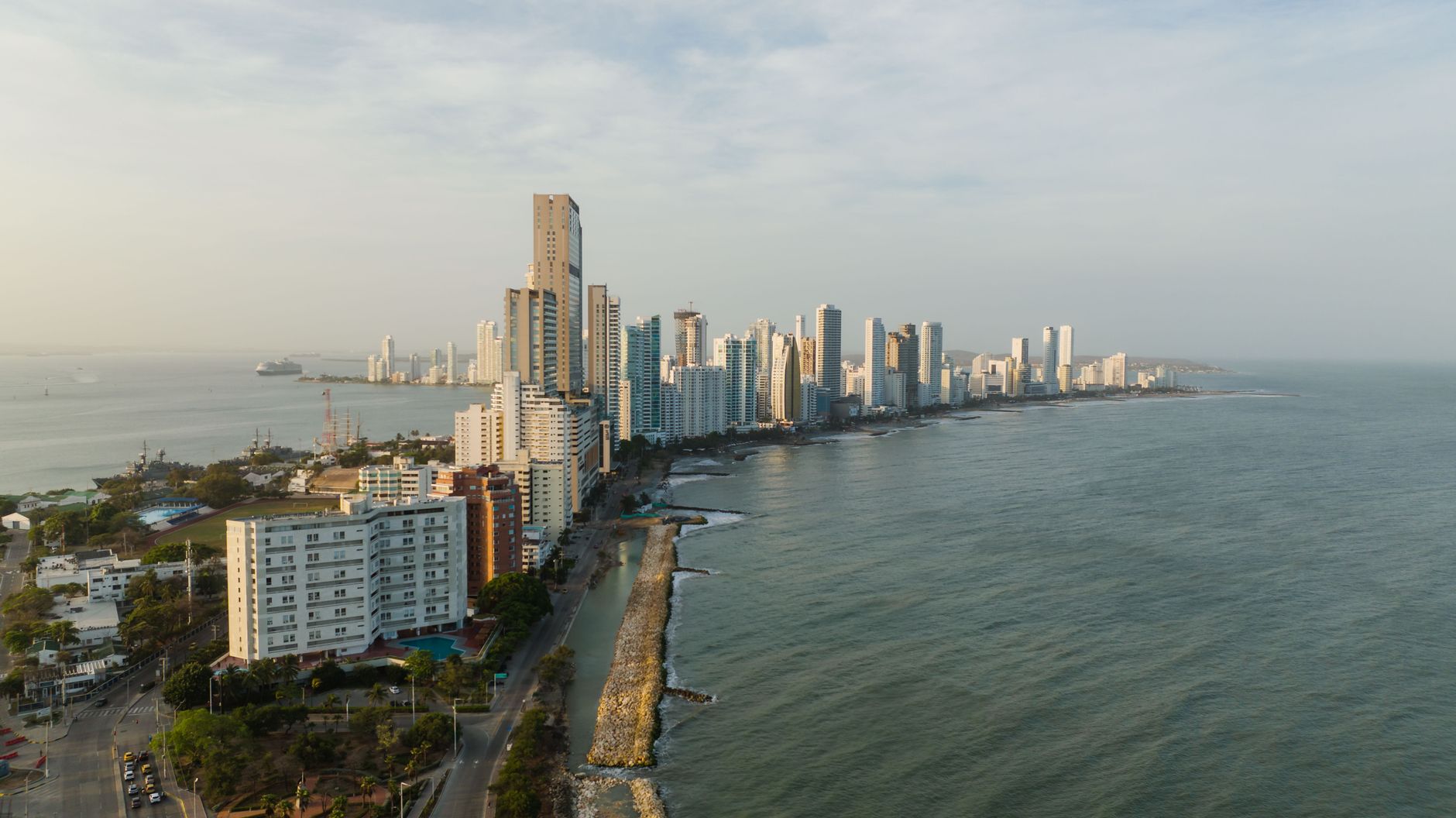
The residential tip of the peninsula: lower and quieter than Bocagrande, facing the bay, with little street retail. Houses and low-rise buildings sit alongside new towers, and single-family homes still exist. It is a dead end: access is through Bocagrande with no through road at the far tip, which keeps it free of passing traffic.
- whether the property faces the bay or the open sea, because the swell, the smell and the façade upkeep are not comparable
- what building height the rules allow on the lot, which is not uniform across the peninsula and is the first fact omitted when a lot is sold
- how ground stability was addressed, given this is land reclaimed from the sea, and what the soil study for the building says
What to verify, step by step
- Ask the utility company for a water and sewer availability certification issued for the property's registry folio, not for the development or the sector.
- Request the latest account statement for each service and ask the company whether there are payment arrangements, refinancings or disputed charges on that meter.
- Check whose name the meter is in and whether it matches the unit being shown: in a copropiedad, individual meters sit next to common-area services billed through the dues.
- Check what belongs to a house in a gated condominio itself and does not change with the sector: where the house's área privada ends and the common area begins, because garden, perimeter wall and front setback are not always the owner's; what the reglamento imposes on façade, extensions and fencing, which is the first thing a buyer wants to change and whether the internal roads, water line and treatment plant belong to the condominio or were handed over to the Distrito, since that decides who repairs them.
- Check in addition what Castillogrande requires in particular, with the authority that imposes it: whether the property faces the bay or the open sea, because the swell, the smell and the façade upkeep are not comparable; what building height the rules allow on the lot, which is not uniform across the peninsula and is the first fact omitted when a lot is sold and how ground stability was addressed, given this is land reclaimed from the sea, and what the soil study for the building says.
- Have the promesa state who answers for balances predating closing, and ask for the paz y salvo (a clearance certificate for the account) before signing; it can be requested without being in Colombia.
Mistakes that cost money
- Treating the bill the seller shows you as an account statement. A bill covers one billing period; a statement shows the balance and any arrangements in force.
- Assuming service because the main runs along the street. A main in front of the lot and a metered connection to the lot are different things, and on land purchases that is exactly where the sums fail.
- Forgetting common-area services. In a copropiedad the lift, pump and lighting consumption arrives through the administration dues, not through the unit's own bill.
Frequently asked questions
- Does the seller's utility debt pass to the buyer?
- The balance is charged against the property, so it is a point to be agreed expressly in the promesa. Ask the utility for a certification of the account status and have your attorney review how that clause was drafted.
- Who issues the availability certification?
- The company that provides the service at that property. The curaduría and the Alcaldía require it as an annex, but they do not issue it.
- Can all of this be requested from outside Colombia?
- The account statement and the certification are requested from the utility and in several cases handled online. Where the request has to come from the owner, the seller files it and you receive the document in writing.
Where to check it
- Alcaldía Mayor de Cartagena de Indias — property tax, betterment levies and District procedures
- Plan de Ordenamiento Territorial de Cartagena — land use, the rules applying to the property and protected land
- Curadurías Urbanas de Cartagena — whether a current building or subdivision permit exists and exactly what it authorises
- Cartagena de Indias — the rules of the municipality Castillogrande belongs to
Official bodies. Specific figures are requested there, not copied from a listing.
Updated 2026-11-06
Interested in a property in this area?
Write to us and we will send you the available options.