An avalúo comercial —a signed appraisal report— is not an opinion about price: it is a document a licensed perito avaluador stands behind. Before any money moves, find out who prepared it, by what method and for whom, because the appraisal the lender orders and the one the seller shows you are two different documents.
The method follows the nature of the property, which is why the appraisal of a retail unit is not assembled like any other. Where comparable units exist in the same sector the perito works by market comparison; where the subject is undeveloped land or a property with no close referents, the residual and replacement-cost methods appear, and those rest on planning and construction assumptions a buyer can read and challenge. On top of that sits a common confusion: the avalúo catastral published by IGAC —the assessed value— is the base for the impuesto predial, the property tax, and never claims to be market value. And an appraisal commissioned by a lender exists to measure that lender's own collateral, under prudential criteria that are not the buyer's. All of it decides money: how much the bank advances, how much the seller asks, and what ends up written in the deed.
A retail unit is bought differently because you are not buying a space but the possibility that someone can trade in it, and that possibility is granted by third parties. Two permissions are needed and nobody bundles them: the one the land-use rules give for that specific lot, and the one the copropiedad's reglamento gives, which need not agree. On top of those sit the tenant's own business permits, applied for activity by activity. The second difference is the relationship with the tenant. A lease of premises for commercial purposes runs under rules distinct from residential tenancies, with an expectation of continuity for the tenant that is worth having a lawyer spell out before signing, because the buyer steps into a contract that already exists and inherits its history. The third is that the unit depends on what lies outside it: façade, signage, pavement, loading area and public access are normally bien común, common property, or public space. What makes the unit profitable, in other words, is not inside its walls and is not decided from within the unit.
Bocagrande works like a mature resale market, with consequences that do not repeat up north. The counterparty is almost never a builder: it is a long-standing owner or, very often, an unsettled sucesión, an estate proceeding, whose heirs live in different countries, so closing depends not on one power of attorney but on several, and on the partition among them. The registry record is old too: it was opened when the building was submitted to the condominium regime, it carries legacy entries such as cancelled mortgages, patrimonio de familia and afectación a vivienda familiar, both family-home protections, or lifted attachments, and the recorded area does not always match a current survey, so you compare the registry record against the deed and against the unit's floor plan. The peninsula is also land reclaimed from the sea under subdivisions the District authorized in their day, and the oldest deeds still carry references to those parcelaciones, the original platting. Day-to-day power sits with the owners' assembly and its manager, so in a tower with a long record of decisions the minutes and the status of the condominium's lawsuits matter more than the brochure.
What is specific to Bocagrande
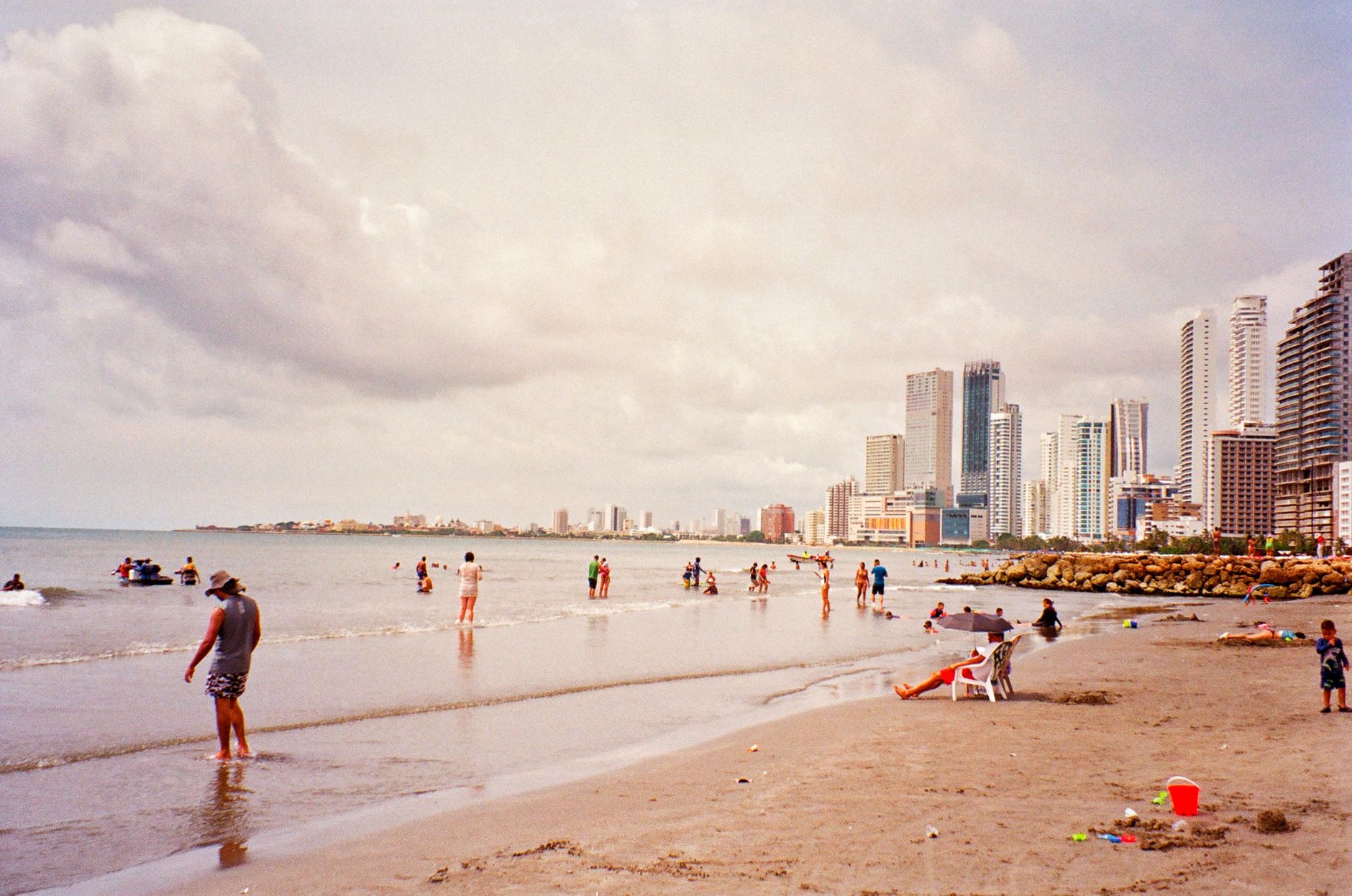
Cartagena's dense, vertical peninsula: open sea on one side, bay on the other, and built out to the last lot. Condominium towers from very different eras, from the sixties to recent construction, on the same block. Groceries, restaurants and beach are walkable, and access is through a few roads that saturate in high season.
- the building's actual age and whether it has a structural vulnerability study, since much of the stock was built under seismic codes earlier than those now in force
- what the condominium bylaws say about daily rentals, which on this peninsula is the difference between being able to rent and not
- how many parking spaces the unit holds in the deed, not in the brochure, because older towers do not have one per apartment
What to verify, step by step
- Ask for the complete appraisal report rather than the summary page: it has to name the signer, the perito's registration, the date and the method used.
- Check the appraiser against the open register kept by the Lonja de Propiedad Raíz de Bolívar, which can be consulted from abroad.
- Compare the area, boundaries and identification of the property in the appraisal against the IGAC cadastral record and the certificado de tradición y libertad, the registry history of the property.
- Go through the items specific to retail units that the appraiser should have had in front of him: whether the POT (the city's land-use plan) allows commercial use on that specific lot and whether the reglamento de propiedad horizontal admits it — two separate permissions, and you need both; whether the particular activity planned requires a concepto de uso de suelo (a land-use ruling) and who applies for it, owner or tenant and how façade, signage, pavement and loading area are allocated, since these are usually bien común even though the unit uses them daily.
- Add what the sector itself forces you to check in Bocagrande: the building's actual age and whether it has a structural vulnerability study, since much of the stock was built under seismic codes earlier than those now in force; what the condominium bylaws say about daily rentals, which on this peninsula is the difference between being able to rent and not and how many parking spaces the unit holds in the deed, not in the brochure, because older towers do not have one per apartment.
- If there will be a mortgage, ask the lender which appraisal it requires and confirm with the Superintendencia Financiera that the institution is supervised before handing over documents or funds.
Mistakes that cost money
- Treating the seller's appraisal as neutral. The seller paid for it and it was written to support the asking figure; still ask for it, but read who commissioned it.
- Asking the appraiser for a number instead of the report. What lets you argue about value are the assumptions and the comparables, not the conclusion.
- Assuming the appraisal replaces a title search. The perito values the property; he does not establish who may sell it.
Frequently asked questions
- Can I commission my own appraisal of a retail unit without being in Cartagena?
- Yes. The perito needs access to the property and its documents, not the buyer's presence; the signed report can be delivered by email.
- Why is the lender's appraisal below the asking price?
- Because it measures the institution's collateral, not the negotiation between the parties. They are two documents with different purposes and it is worth having both.
- Is the avalúo catastral useful for negotiating?
- It is useful for understanding the base of the impuesto predial, which is what IGAC and the District publish. For market value you order an appraisal from a registered perito.
Where to check it
- Lonja de Propiedad Raíz de Bolívar — commercial appraisals and appraisers listed on the open register
- Instituto Geográfico Agustín Codazzi — the cadastral record, area, boundaries and assessed value of the property
- Superintendencia Financiera de Colombia — whether a trust company exists and is supervised, before transferring money to a patrimonio autónomo
- Cartagena de Indias — the rules of the municipality Bocagrande belongs to
Official bodies. Specific figures are requested there, not copied from a listing.
Updated 2026-11-06
Interested in a property in this area?
Write to us and we will send you the available options.