A title review tells you who may sell; a technical inspection tells you what is being sold. They are two separate engagements, both paid for by the buyer, and in Bocagrande the second one is usually skipped because the buyer is not in the city to open the door.
What gets inspected is not the same checklist for every property: when what you are buying is a serviced lot, the report has to address what the nature of that property actually puts at risk, not a generic form about damp patches and sockets. That matters for money and for timing. For money, because a repair not found before the promesa de compraventa is signed gets paid for afterwards by the buyer, and in a propiedad horizontal (condominium regime) it can end up shared among all owners through a special assessment. For timing, because before the promesa whatever turns up is a matter for negotiation, and afterwards it is only a claim. The report is signed by a professional who answers for what it says; nobody signs the brochure.
A serviced lot is bought differently because what you acquire is a capacity to build, not a built thing. The value sits in what the rules allow on that specific parcel and in the state of the surrounding development, not in what you see on a site visit, which looks much the same on every lot of the block. Three consequences follow. First, the folio tends to be young, since it was created by splitting a larger parent parcel, so the useful history lives in that parent folio and in how areas, roads and public land dedications were divided. Second, the developer does not vanish with the sale: if water, sewer, road or green- area works are still unbuilt, or obligaciones urbanísticas (duties owed to the city by the developer) are still outstanding, there remains a counterparty, and it is worth knowing who answers for them and against what security. Third, the asset produces nothing until it is built on, while still generating impuesto predial, development dues and the cost of watching over empty land. For a buyer abroad, a lot also means a permit process and a construction job run from Colombia, by someone authorized to sign.
Bocagrande works like a mature resale market, with consequences that do not repeat up north. The counterparty is almost never a builder: it is a long-standing owner or, very often, an unsettled sucesión, an estate proceeding, whose heirs live in different countries, so closing depends not on one power of attorney but on several, and on the partition among them. The registry record is old too: it was opened when the building was submitted to the condominium regime, it carries legacy entries such as cancelled mortgages, patrimonio de familia and afectación a vivienda familiar, both family-home protections, or lifted attachments, and the recorded area does not always match a current survey, so you compare the registry record against the deed and against the unit's floor plan. The peninsula is also land reclaimed from the sea under subdivisions the District authorized in their day, and the oldest deeds still carry references to those parcelaciones, the original platting. Day-to-day power sits with the owners' assembly and its manager, so in a tower with a long record of decisions the minutes and the status of the condominium's lawsuits matter more than the brochure.
What is specific to Bocagrande
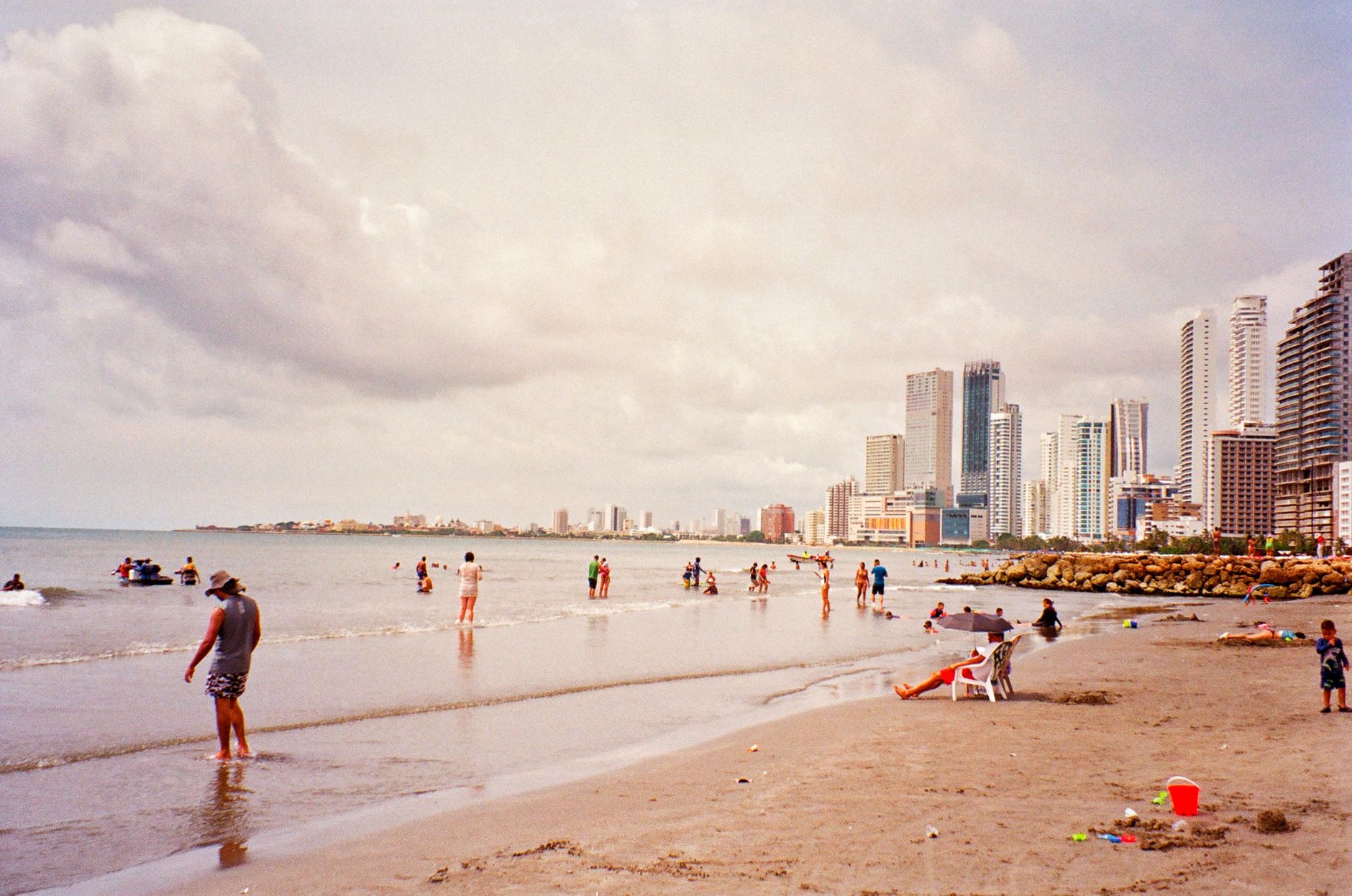
Cartagena's dense, vertical peninsula: open sea on one side, bay on the other, and built out to the last lot. Condominium towers from very different eras, from the sixties to recent construction, on the same block. Groceries, restaurants and beach are walkable, and access is through a few roads that saturate in high season.
- the building's actual age and whether it has a structural vulnerability study, since much of the stock was built under seismic codes earlier than those now in force
- what the condominium bylaws say about daily rentals, which on this peninsula is the difference between being able to rent and not
- how many parking spaces the unit holds in the deed, not in the brochure, because older towers do not have one per apartment
What to verify, step by step
- Ask the curaduría urbana (the private permitting office) for the licencia de construcción and the approved plans, and check what use, area and height that permit actually authorised against what you are being shown. Anything built beyond it is not cured by the deed.
- What the report has to address point by point for a serviced lot: whether the lot has been split out with its own matrícula inmobiliaria or still sits inside a larger undivided parcel; what the rules let you build on that specific lot —use, height, setbacks, ground coverage— and whether the licencia de urbanismo is current and which obligaciones urbanísticas (developer duties owed to the city) are still outstanding and whether they pass to the buyer, since they fall due before you can build.
- And what the same report should pick up for the sector in Bocagrande: the building's actual age and whether it has a structural vulnerability study, since much of the stock was built under seismic codes earlier than those now in force; what the condominium bylaws say about daily rentals, which on this peninsula is the difference between being able to rent and not and how many parking spaces the unit holds in the deed, not in the brochure, because older towers do not have one per apartment.
- Engage the visit with an engineer or architect you hire yourself, not the one the seller offers, and require a written report with dated photographs, a signature and the professional's licence number. Ask Camacol Bolívar who carries out technical surveys in the region and ask for references you can check.
- Agree in writing with the seller on the date of the visit and on access to the property before signing the promesa, and attach the report to the promesa together with the agreed repairs and who pays for them.
- Ask the District whether any administrative proceeding is open against the property for building without a permit or for breaching planning rules, because that follows the property and not the seller.
Mistakes that cost money
- Accepting the report the seller or the developer hands over. The useful report is the one the buyer commissioned and can question.
- Leaving the inspection until after the promesa, when the price is already agreed. Whatever surfaces then is argued from the weaker position.
- Confusing the technical inspection with the title review. One looks at the construction and the other at the chain of ownership; you need both, and not from the same person.
Frequently asked questions
- Can the inspection be done without being in Cartagena?
- Yes, and it usually is: you hire the professional, arrange access with the seller and receive the signed report. What you should not delegate is choosing who does it.
- Does the inspection change with the type of property?
- In substance, yes. What has to be verified on a serviced lot comes from the nature of the property —what is privately owned, what is common property, what the permit authorises— and not from a general list of finishes.
- Who pays for repairs the report turns up?
- Whoever agreed to in writing. If the report is attached to the promesa with the fixes and who owes them, you have something to enforce; if it lives in an email, you do not.
Where to check it
- Curadurías Urbanas de Cartagena — whether a current building or subdivision permit exists and exactly what it authorises
- Camacol Bolívar — the industry's own figures on housing starts and launches in Bolívar
- Alcaldía Mayor de Cartagena de Indias — property tax, betterment levies and District procedures
- Cartagena de Indias — the rules of the municipality Bocagrande belongs to
Official bodies. Specific figures are requested there, not copied from a listing.
Updated 2026-11-06
Interested in a property in this area?
Write to us and we will send you the available options.