Closing is not a single payment: different taxes are settled with different authorities, and some are withheld by someone who is not a party to the deal. The nature of the property changes what gets settled, which is why the closing list for a lot is not the closing list for an unit under propiedad horizontal.
The question that really decides money is not how much, but who settles it and what happens if it was settled wrongly. The notaría withholds and declares in the deed whatever the law tells it to; the registry office charges its own fees to record the transfer; the District answers for the impuesto predial (annual property tax) and for any contribución de valorización (betterment levy) attached to the land; and the DIAN is the authority that states, according to the nature and the intended use of the property, which withholding applies to the transaction and who is obliged to apply it. When what you are buying is an office unit, that answer shifts: undeveloped land, an unit under propiedad horizontal and a property destined for a commercial activity are not settled the same way. And what was left unpaid in the past does not stay with the seller: the land arrives with its own history, which is why the paz y salvo (clearance certificate) is requested before signing and not after.
An office unit is bought differently because it does not live on passing footfall but on the building's ability to work as a business address. What makes it usable are services the unit does not control: the hours lifts and security actually run, the air conditioning and how it is metered, backup power, connectivity and visitor parking. None of that is fixed inside the unit and all of it runs through the administración, so the review looks at the building rather than at the door. The second difference is destinación, the recorded permitted use: in mixed-use towers, units whose registered use is residential are routinely sold as offices, and the mismatch between what the deed says, what the reglamento allows and what planning rules require is what later blocks registering the activity or receiving the public. The third is the rental market: an office tenant is a company choosing on address, floor area and building services, and is replaced by another of the same kind, so occupancy depends on the state of the whole tower far more than on the state of the unit.
In Castillogrande the typical deal is not a unit in a condominium but a house and its lot, which puts the weight of the file back on the chain of title to the land: you climb through the deeds to the parcelación, the original subdivision that created the block, because those platting deeds registered conditions, setbacks and easements that still bind and that are invisible from the street. There is no building manager to issue a paz y salvo, a no-arrears certificate, and no assembly to settle anything, so boundary questions with a neighbor are argued between private parties and what governs is the title and the survey, not a set of house rules. The counterparty is usually an old city family and, fairly often, a family company that owns the property: then you must decide whether to buy the real estate or the company's shares, two different transactions with different paperwork and different exposure, and request the certificado de existencia y representación, the corporate good-standing and signing-authority certificate, together with the resolution approving the sale. And because the neighborhood is fully built out, any construction is permitted on an already developed lot, with neighbors entitled to take part in the proceeding.
What is specific to Castillogrande
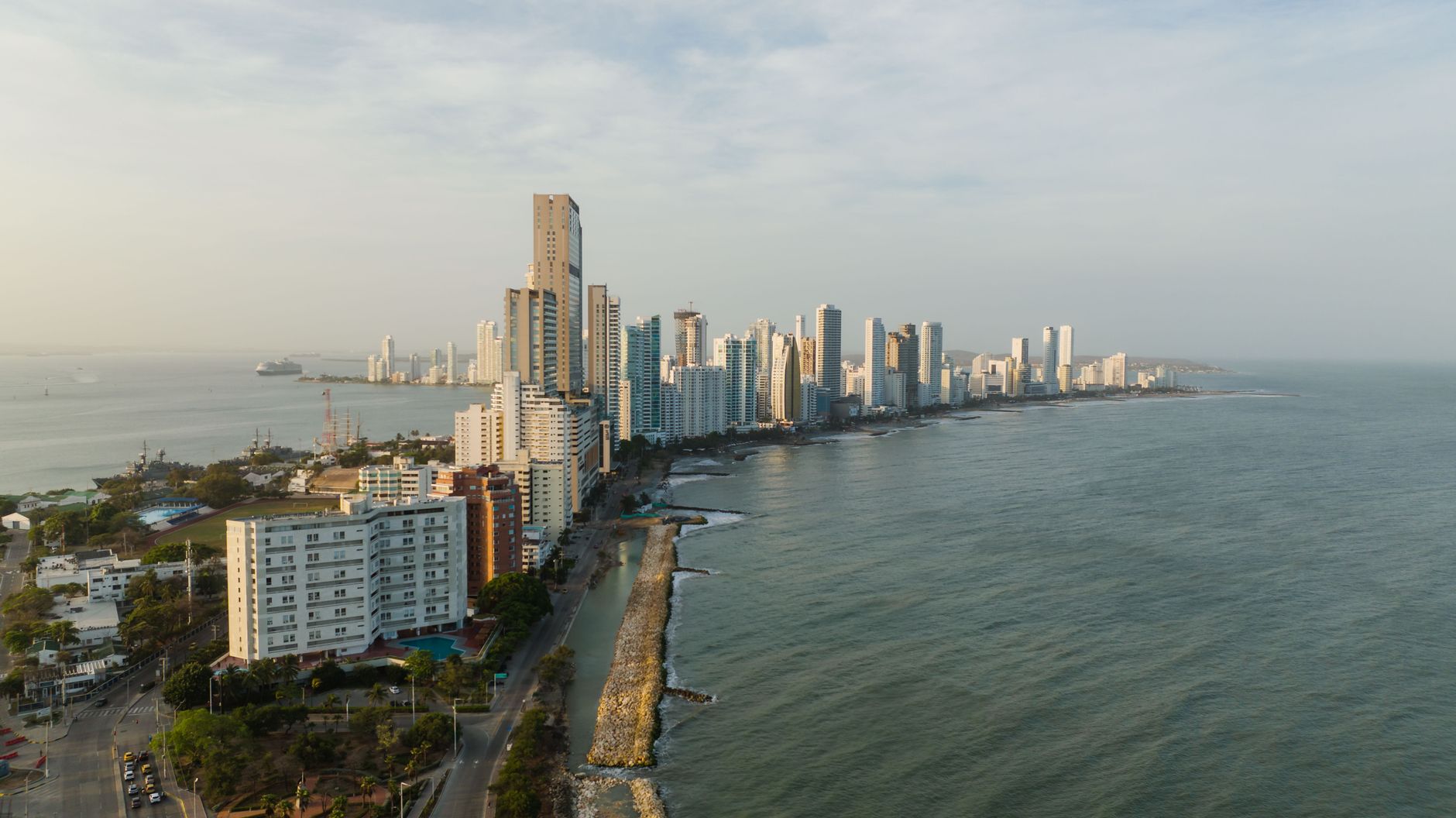
The residential tip of the peninsula: lower and quieter than Bocagrande, facing the bay, with little street retail. Houses and low-rise buildings sit alongside new towers, and single-family homes still exist. It is a dead end: access is through Bocagrande with no through road at the far tip, which keeps it free of passing traffic.
- whether the property faces the bay or the open sea, because the swell, the smell and the façade upkeep are not comparable
- what building height the rules allow on the lot, which is not uniform across the peninsula and is the first fact omitted when a lot is sold
- how ground stability was addressed, given this is land reclaimed from the sea, and what the soil study for the building says
What to verify, step by step
- Ask the DIAN which withholdings and which taxes are settled on a sale like yours, who is obliged to apply them and at what point in the closing. The answer depends on the nature of the property and on the seller's status, not on what the parties agree.
- What the nature of an office unit forces you to check before accepting the closing statement: whether the deed's permitted use is office or residential, because in mixed-use towers residential units are routinely sold as offices; the hours the lifts, air conditioning and security actually operate, and whether use outside those hours is billed separately and whether the administración requires a declared destinación (recorded permitted use) and prior notice to receive the public, and which visitor parking is assigned to the unit.
- Ask the District for the paz y salvo on the impuesto predial and for the status of any betterment levy on the property in Castillogrande, recently dated and issued against the registry folio rather than against the seller's name.
- Order the certificado de tradición y libertad from the Superintendencia de Notariado y Registro and read whether any attachment, mortgage or encumbrance is still to be released, because that is cleared before the transfer can be recorded.
- Ask the building manager for the paz y salvo on ordinary dues and on approved special assessments, and ask whether any has been approved but not yet billed.
- Ask the notaría for the closing statement in writing before signing, with each item listed separately and with the authority each one goes to, and have your accountant review it before you transfer.
Mistakes that cost money
- Negotiating who pays what without knowing who is legally obliged to withhold. Splitting costs between the parties does not displace the statutory duty, and the shortfall shows up in the deed or at recording.
- Requesting the clearance certificate in the seller's name. It is the land that is charged: ask for it against the matrícula inmobiliaria (registry folio).
- Treating signature as the end of the closing. Until the deed is recorded, anything still unsettled keeps holding up registration.
Frequently asked questions
- Why do you not publish what closing costs?
- Because rates and taxable bases change, and because they depend on the nature of the property and on the seller's status. The actual statement comes from the notaría in writing and is confirmed by the DIAN.
- Does anything change if I buy an office unit rather than something else?
- What gets settled, and with whom. That is why the first step is to ask the DIAN about your specific transaction, with the property's intended use on the table.
- Who do I ask for the clearance certificate?
- Property tax and betterment levy, the District; dues, the condominium manager; and the state of encumbrances, the certificado de tradición y libertad.
Where to check it
- DIAN — the tax ID, withholding on sale and the capital gains tax
- Alcaldía Mayor de Cartagena de Indias — property tax, betterment levies and District procedures
- Superintendencia de Notariado y Registro — the certificate of title and encumbrances, which is the property's full history
- Cartagena de Indias — the rules of the municipality Castillogrande belongs to
Official bodies. Specific figures are requested there, not copied from a listing.
Updated 2026-11-06
Interested in a property in this area?
Write to us and we will send you the available options.