The purchase gets recorded even when the money came in badly, and that is the trap: the deed is registered and the investment is not. A Venezuelan buyer discovers the gap when it is time to sell or to move funds out, which is when it can no longer be fixed without a procedure.
This is not the same as proving where the money came from. Proving the source is the due diligence the real estate sector is required to carry out and which the UIAF explains. Registering foreign investment is an exchange-control operation: the funds have to enter through the regulated foreign-exchange market with their declaración de cambio (exchange declaration), through an authorised intermediary, and the Banco de la República is the body that states how it is registered, under which heading and in whose name. What decides money is the name: whoever sends the funds, whoever appears on the escritura and whoever holds the registration must be the same party, because that registration is what later supports the operation in reverse. And if the money goes into a patrimonio autónomo (a trust estate) before reaching the deed, there is one more check: that the fiduciaria exists and is supervised, which you verify at the Superintendencia Financiera and not in the project brochure.
What decides this purchase is not the price but traceability: if the money has passed through accounts in third countries, every leg of that route has to be documentable, and the paperwork is assembled before the transaction starts, not when the bank asks for it. The transfer has to enter through the regulated exchange market with its declaración de cambio and be registered as foreign investment with the Banco de la República, and if the originating account is not in the same country as your identity document, ask the bank and the Banco de la República explicitly how that case is recorded. The poder for signing from abroad depends on where you live now rather than on your nationality: the Colombian consul in that country, or that country's apostille, with the Cancillería confirming which applies. Visas and the cédula de extranjería are for Migración Colombia, which is who distinguishes a stay permit from a visa. And the tax question is whether a treaty exists between Colombia and the country where you are tax resident, and what it says about rental income and about ganancia ocasional, with an accountant in each country.
In Castillogrande the typical deal is not a unit in a condominium but a house and its lot, which puts the weight of the file back on the chain of title to the land: you climb through the deeds to the parcelación, the original subdivision that created the block, because those platting deeds registered conditions, setbacks and easements that still bind and that are invisible from the street. There is no building manager to issue a paz y salvo, a no-arrears certificate, and no assembly to settle anything, so boundary questions with a neighbor are argued between private parties and what governs is the title and the survey, not a set of house rules. The counterparty is usually an old city family and, fairly often, a family company that owns the property: then you must decide whether to buy the real estate or the company's shares, two different transactions with different paperwork and different exposure, and request the certificado de existencia y representación, the corporate good-standing and signing-authority certificate, together with the resolution approving the sale. And because the neighborhood is fully built out, any construction is permitted on an already developed lot, with neighbors entitled to take part in the proceeding.
What is specific to Castillogrande
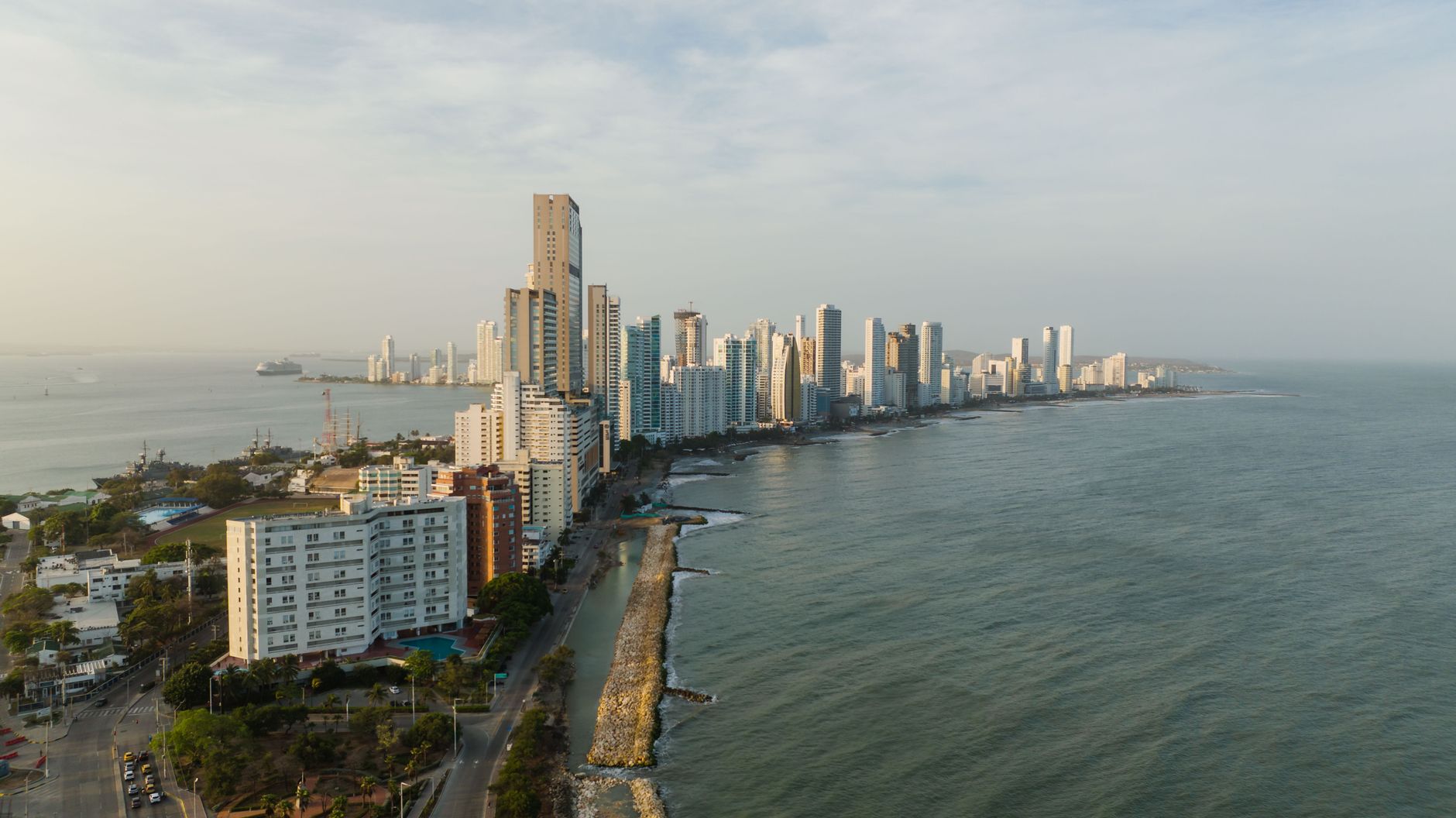
The residential tip of the peninsula: lower and quieter than Bocagrande, facing the bay, with little street retail. Houses and low-rise buildings sit alongside new towers, and single-family homes still exist. It is a dead end: access is through Bocagrande with no through road at the far tip, which keeps it free of passing traffic.
- whether the property faces the bay or the open sea, because the swell, the smell and the façade upkeep are not comparable
- what building height the rules allow on the lot, which is not uniform across the peninsula and is the first fact omitted when a lot is sold
- how ground stability was addressed, given this is land reclaimed from the sea, and what the soil study for the building says
What to verify, step by step
- Before transferring anything, ask the Banco de la República which channel the funds must use, which declaración de cambio supports them, under which heading an investment in real estate is registered and in whose name the registration ends up.
- What a Venezuelan buyer has to settle with their bank and with the intermediary before the first transfer: that the money's full route is documented leg by leg before the transaction starts, third countries included; how the Banco de la República records a transfer whose originating account is not in the country of your identity document and whether a treaty exists between Colombia and the country where you are tax resident, and what it says about rental income and about ganancia ocasional, with an accountant in each country.
- Ask the foreign-exchange intermediary in writing for proof of the operation and a copy of the exchange declaration, and keep them with the deed: that is the support you will be asked for years later.
- If the money enters a patrimonio autónomo or a project trust in Castillogrande, verify at the Superintendencia Financiera that the fiduciaria exists and is supervised, and confirm the destination account belongs to the trust estate and not to the developer.
- Assemble the source-of-funds documentation the UIAF sets out as the sector's duty, because the broker and the notaría are required to request it and the closing stops without it.
- Confirm that the name and identification number on the transfer, on the promesa and on the deed match exactly, and correct any difference before signing.
Mistakes that cost money
- Wiring outside the regulated exchange market because the ordinary transfer arrived sooner. The purchase records anyway and the investment goes unregistered.
- Letting a relative or an account in another name send the money. The registration follows whoever sent it, and that name has to be the one on the deed.
- Confusing source-of-funds evidence with exchange registration. They are two duties before two different authorities, and meeting one does not cover the other.
Frequently asked questions
- How is this different from proving the source of funds?
- Source of funds is the due diligence the UIAF explains and which the broker and the notaría require. Exchange registration sits with the Banco de la República and is what supports the investment. You need both.
- Can a Venezuelan buyer register the investment after signing?
- That is precisely the question to put to the Banco de la República before transferring, because a later correction is a separate procedure. Do not decide it on what the seller tells you.
- Who do I ask whether the project's trust company is sound?
- The Superintendencia Financiera, which is who states whether that company exists and is supervised. Before transferring money to a trust estate, that check comes first.
Where to check it
- Banco de la República — registration of foreign investment and the official exchange rate
- Superintendencia Financiera de Colombia — whether a trust company exists and is supervised, before transferring money to a patrimonio autónomo
- UIAF — the anti-money-laundering obligations that apply to the real estate sector
- Cartagena de Indias — the rules of the municipality Castillogrande belongs to
Official bodies. Specific figures are requested there, not copied from a listing.
Updated 2026-11-06
Interested in a property in this area?
Write to us and we will send you the available options.