Water running on the day of the visit does not prove that availability has been certified, and the meter feeding a serviced lot is not always registered to the property itself. These are two separate documents, issued by different bodies, and a buyer who asks for neither inherits whatever was never checked.
Service availability is evidenced by a certification from the utility company for that specific property, and it is the document the curaduría looks at when a permit is requested. A seller's word, a temporary hook-up or a line drawn from a neighbour are not the same thing, and the difference decides whether a serviced lot can be lived in, conveyed or remodelled. Alongside that sits the bill: in Colombia utility balances follow the property rather than the person who ran them up, so the account status and the name recorded on the meter belong in the promesa de compraventa (the binding promise of sale) and not in an act of trust. How much is owed is for the utility to state; who pays it is what gets agreed in writing before signing.
A serviced lot is bought differently because what you acquire is a capacity to build, not a built thing. The value sits in what the rules allow on that specific parcel and in the state of the surrounding development, not in what you see on a site visit, which looks much the same on every lot of the block. Three consequences follow. First, the folio tends to be young, since it was created by splitting a larger parent parcel, so the useful history lives in that parent folio and in how areas, roads and public land dedications were divided. Second, the developer does not vanish with the sale: if water, sewer, road or green- area works are still unbuilt, or obligaciones urbanísticas (duties owed to the city by the developer) are still outstanding, there remains a counterparty, and it is worth knowing who answers for them and against what security. Third, the asset produces nothing until it is built on, while still generating impuesto predial, development dues and the cost of watching over empty land. For a buyer abroad, a lot also means a permit process and a construction job run from Colombia, by someone authorized to sign.
What sets Cielo Mar apart is that much of the buying happens before the property legally exists. Units sell off plan, and the counterparty is not an owner but a fiduciaria, a trust company, managing a patrimonio autónomo, a segregated trust estate, into which the landowner contributed the site. That changes the whole process. The first document signed is not a deed but an enrollment in the project; the money goes into a trust account rather than to a seller; and the deed is granted once the punto de equilibrio, the pre-sales break-even threshold, is reached and the building goes up, so in the early stage there is no unit folio to certify because none has been opened. Ask for the trust agreement and ask what happens if that threshold is never reached, who returns the money and on what terms. Who decides changes too: the governing document is the permit issued by the curaduría urbana, the private licensing office, and the condominium bylaws are still unregistered, so you read a draft. Utilities may be run by private operators belonging to the development itself, meaning the supply relationship does not start with the city water company.
What is specific to Cielo Mar
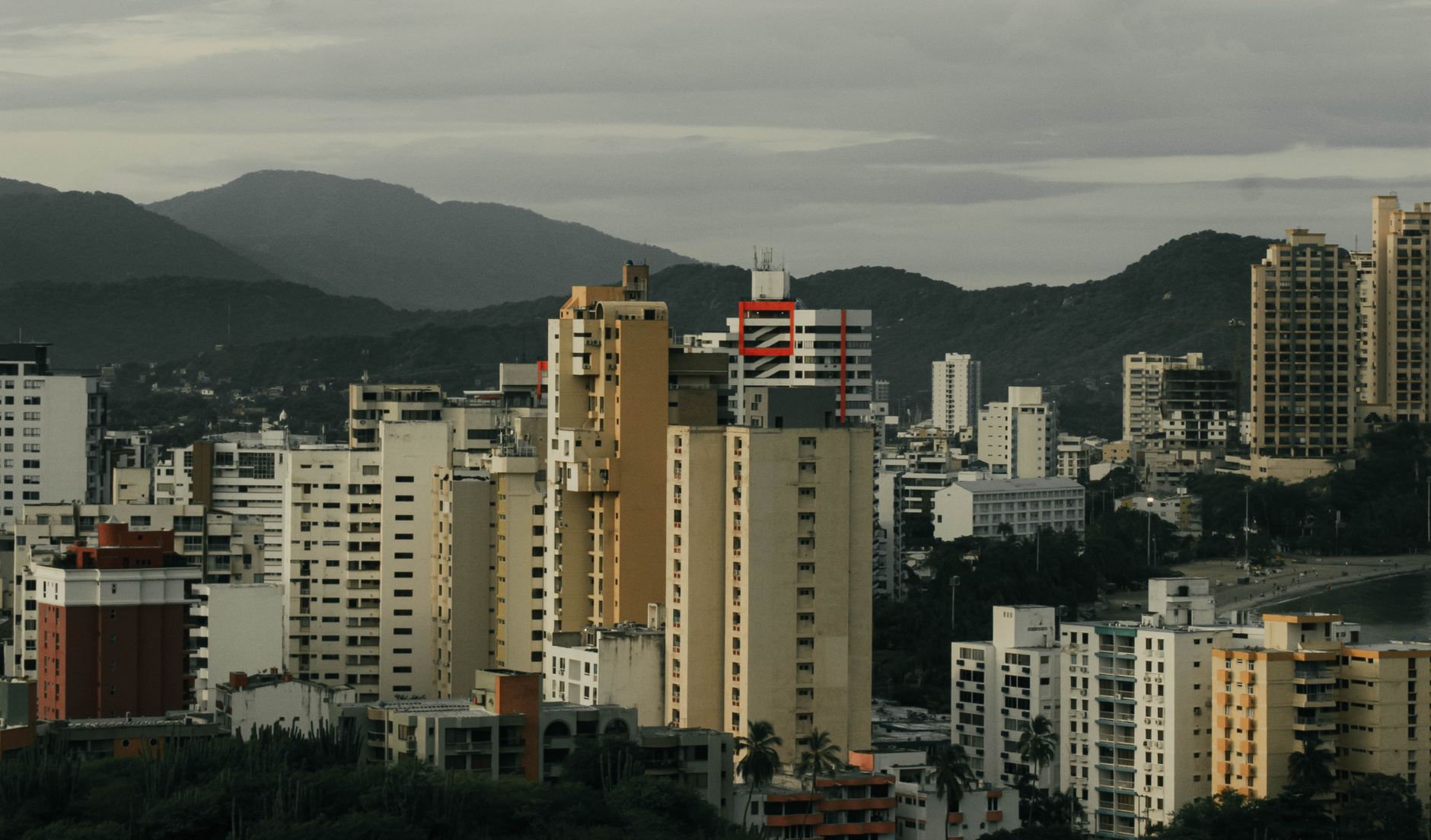
Morros continued northward: newer development and less established street retail. Recently built towers with undeveloped lots still sitting between them. It depends entirely on the Anillo Vial; groceries and school are not walkable.
- what has been permitted on the neighbouring lot, because a new tower next door changes the view and the sunlight you paid for
- how drinking water arrives and where the sewage goes, which along this northern stretch is not always the public network
- whether the building permit is current and matches what the sales office is offering
What to verify, step by step
- Ask the utility company for a water and sewer availability certification issued for the property's registry folio, not for the development or the sector.
- Request the latest account statement for each service and ask the company whether there are payment arrangements, refinancings or disputed charges on that meter.
- Check whose name the meter is in and whether it matches the unit being shown: in a copropiedad, individual meters sit next to common-area services billed through the dues.
- Check what belongs to a serviced lot itself and does not change with the sector: whether the lot has been split out with its own matrícula inmobiliaria or still sits inside a larger undivided parcel; what the rules let you build on that specific lot —use, height, setbacks, ground coverage— and whether the licencia de urbanismo is current and which obligaciones urbanísticas (developer duties owed to the city) are still outstanding and whether they pass to the buyer, since they fall due before you can build.
- Check in addition what Cielo Mar requires in particular, with the authority that imposes it: what has been permitted on the neighbouring lot, because a new tower next door changes the view and the sunlight you paid for; how drinking water arrives and where the sewage goes, which along this northern stretch is not always the public network and whether the building permit is current and matches what the sales office is offering.
- Have the promesa state who answers for balances predating closing, and ask for the paz y salvo (a clearance certificate for the account) before signing; it can be requested without being in Colombia.
Mistakes that cost money
- Treating the bill the seller shows you as an account statement. A bill covers one billing period; a statement shows the balance and any arrangements in force.
- Assuming service because the main runs along the street. A main in front of the lot and a metered connection to the lot are different things, and on land purchases that is exactly where the sums fail.
- Forgetting common-area services. In a copropiedad the lift, pump and lighting consumption arrives through the administration dues, not through the unit's own bill.
Frequently asked questions
- Does the seller's utility debt pass to the buyer?
- The balance is charged against the property, so it is a point to be agreed expressly in the promesa. Ask the utility for a certification of the account status and have your attorney review how that clause was drafted.
- Who issues the availability certification?
- The company that provides the service at that property. The curaduría and the Alcaldía require it as an annex, but they do not issue it.
- Can all of this be requested from outside Colombia?
- The account statement and the certification are requested from the utility and in several cases handled online. Where the request has to come from the owner, the seller files it and you receive the document in writing.
Where to check it
- Alcaldía Mayor de Cartagena de Indias — property tax, betterment levies and District procedures
- Plan de Ordenamiento Territorial de Cartagena — land use, the rules applying to the property and protected land
- Curadurías Urbanas de Cartagena — whether a current building or subdivision permit exists and exactly what it authorises
- Cartagena de Indias — the rules of the municipality Cielo Mar belongs to
Official bodies. Specific figures are requested there, not copied from a listing.
Updated 2026-11-06
Interested in a property in this area?
Write to us and we will send you the available options.